★ Competition – win a Konus Wild riflescope worth £90 – enter here! ★

WÜLF Defender 30 review
The UK-designed WÜLF Defender 30 combines premium ED glass, Zero-Stop turrets, and a versatile 3-15x44 specification to offer high-end optical performance for both target and field

I first came across the WÜLF scope brand last year, when I was impressed with the Lightning 30E model I tested (September 2025 issue).
What is the price of the WÜLF Defender 30?
At £299.99, WÜLF’s Defender 30 is almost twice the price and, according to distributors Elite Optical, this UK-designed model is aimed at the more discerning airgunner, be they range or field orientated.
Certainly, my first impression was that the Defender 30 is high end. Its hefty weight suggests a reassuring level of build quality and like many premium brands, it’s supplied sans mounts. While a ready-to-fit scope is great for newbies and budget-conscious shooters, it’s always preferable to mount a quality sight with better-engineered rings of your own preference. You’ll need the 30mm type.

What accessories are included in the WÜLF Defender 30 box?
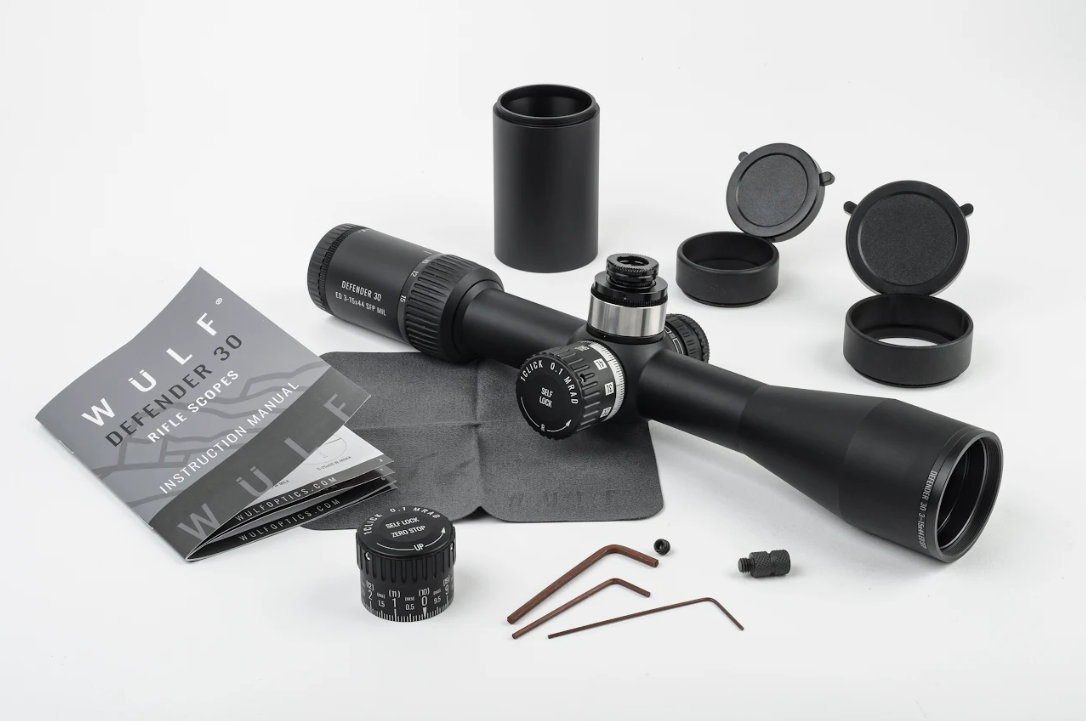
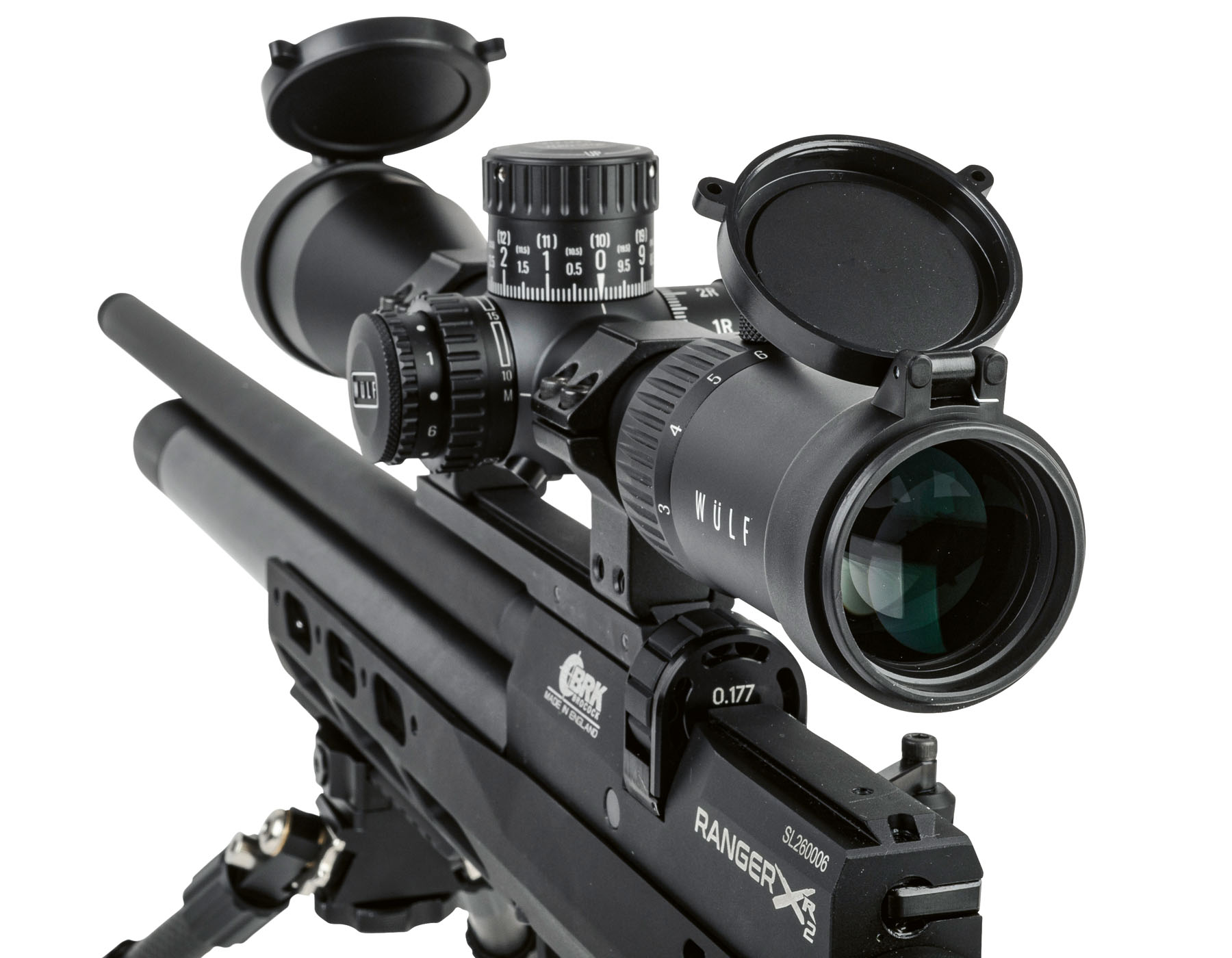
Not that this WÜLF is particularly shy of “extras” in the box, mind you. It comes with a screw-on 75mm sunshade, flip-up covers to keep its ED (Extra Light Dispersion) glass protected and a screw-in zoom throw lever.
On top of that, there’s a six-brightness illuminated, glass-etched MIL-type reticle, push/ pull turrets with Zero-Stop elevation system, sidewheel parallax adjustment and a quick-focus eyepiece. The icing on the cake is WÜLF’s Titanium lifetime warranty.
So, even if you have to invest in mounts, you still get a lot for your £300. Not to mention its slightly unorthodox magnification spec. It’s almost as if WÜLF has looked at the growing popularity of the 3-12x and 4-16x zoom market…then designed something in the middle and stuck on an oversize 44mm diameter objective for good measure.

How good is the WÜLF Defender 30 ED glass and optical clarity?
Truth be told, I’m not sure such a specification is needed in addition to what exists. What’s probably more important to shooters is optical clarity. The good news is that WÜLF has lost nothing to image quality in its quest to push the boundaries of magnification range.
In my tests at 3x, 6x, 10x and 15x (see the Optical Performance panel), this Defender 30 gave a good account of itself. It’s easily on a par, if not better than most scopes available in the £300-£400 price range. My tests are, of course, on paper and as absolute as they are, it’s in the real world – the field; the range – where optical performance is judged more practically. In that respect, I was not disappointed.

Is the WÜLF Defender 30 suitable for low-light hunting?
Between 6x and 10x magnification, the range I most commonly shoot within, the Defender 30’s sight picture was bright and crisp, with no colour fringing, glare or milkiness. This WÜLF’s lens arrays are fully multi-coated, and the combination of the premium ED glass used in the 44mm diameter objective with the 30mm body tube – made from 6063 T-06 aluminium no less – really serves to deliver an image that helps pick out the finest of details on your target.
It coped well under all lighting conditions. I didn’t need to screw-in the sunshade, though it’s nice to know it’s there should you need to combat high-contrast scenarios. And the lenses’ ability to clearly render darker target areas was extraordinary, especially when the scope was set around the 10x mark. Hunters controlling pests at dusk and dawn will certainly appreciate this.


How does the WÜLF Defender 30 illuminated reticle perform?
The glass-etched reticle also assists here, in that its central section can be red-illuminated at the turn of the outer knob on the left-hand turret. There are six intensity settings – number 1 to 6 – each of which has an “off” setting between. This makes it easy to recall your last setting should you have to quickly flick between black and red. It’s powered by the usual CR2032 button cell battery.
Illuminated reticles – dubbed “IR” in dayscope nomenclature and not to be confused with infra-red attributes of nightscopes – are extremely practical for target shooters and hunters alike, but especially the latter. Trying to get an aim on that pigeon roosting in a dense mass of branches is made a lot easier when you can actually distinguish the crosshair from the twigs.

What are the features of the WÜLF W-MIL6 reticle?
The 3-15×44 Defender 30 is equipped with WÜLF’s W-MIL6 type crosshair, which is based around “milliradian” subtends, or aiming reference marks. These are set at 1MIL increments, with half-MIL divisions. There’s also some numbering – in two-MIL intervals – which assists should you want to use the milliradian system for range-finding.


Is the WÜLF Defender 30 First or Second Focal Plane?
It should be noted that the reticle is situated in the second focal plane (SFP), so as you zoom through the magnification range, the size of the target alters in relation to the subtends (see SFP vs FFP panel). So, for the MIL spacings to be true, this particular SFP scope must be set to 15x power. At that magnification, one MIL will then – and only then – represent 10mm at 10m, 20mm at 20m and so on.
While the W-MIL6 is multi-faceted, I didn’t find it confusing to use and having some of the stadia numbered helped. Although the subtends on the vertical and horizontal “wires” all look like conventional notches, some are elongated triangles. And in the lower quadrant, each MIL spacing is designated by a mini dot at the centre. However, you need sharp eyes to realise these little idiosyncrasies exist because even at full power, they’re not immediately obvious.


How does the WÜLF Defender 30 side parallax adjustment work?
The Defender 30’s magnification ring turns very smoothly, though with more than 180 degrees of rotation required to get to either end of the 3-15x range, it’s worth deploying its zoom throw lever. Well done to WÜLF for supplying a blanking plug should you opt not to. And bonus points for supplying the hex wrench to remove it. Score one more for the well-designed lever, too. Knurled and not so big as to snag on clothing, I found it extremely practical.
Not so practical, however, was the Defender 30’s parallax adjustment (P/A) system, even though it’s presented in a sidewheel format, much favoured by airgunners. While it succeeds in its primary function of eliminating parallax error right down to 10 metres, I struggled to use its secondary benefit, namely that of fine-focus range-finding. To be fair, not many scopes under 24x power are that good at it, but I’d still expect to range-find to within three metres or so with a 15x magnification scope.
On the WÜLF, while there’s no extension sidewheel fitting, there’s actually good space between the 10, 15, 30 and 50m marks on its P/A vernier to assist with ranging. However, my sample scope’s integral P/A wheel felt a bit “slack” in use, so I couldn’t achieve a consistent point on the vernier when trying to fine-focus the target.
So, while I’d recommend it should always be set to approximate the distance of your intended target for parallax purposes, range-finding is best achieved by “bracketing” your target with the reticle. At least the W-MIL6 is perfect for doing that!

What are the benefits of WÜLF Defender 30 Zero-Stop turrets?
Multi-stadia reticles like the WÜLF’s aren’t just good for assisting range estimation, though. They also offer lots of hold-over, hold-under and windage reference points. Additionally, the Defender 30 comes with external turrets so you can “dial in” a new zero for every range, thereby always aiming dead centre.
The WÜLF’s elevation and windage adjustment turrets are superb. Their verniers are clearly marked and they offer a very positive click in 0.1MRAD increments, with no fewer than 100 clicks (i.e. 10 MILs) per full rotation. Both can easily be aligned to “0” once you’ve set your rifle’s zero and they’re lockable to avoid inadvertent changes. Pull out to adjust them; push in to lock them. What’s more, the elevation turret comes with a Zero-Stop feature (see Setting up the Zero-Stop System panel).
The Defender has been designed for use on rim and centrefire rifles, so I’ve no doubt it’ll be more than up to the task of handling airguns. While I only mounted it on a recoilless PCP during my test period, I spun the life out of the turrets and experienced no issues.
That said, because of its weight, I’d be inclined to use a one-piece mount if you use it on a recoiling springer. In my experience with such air rifles, heavier scopes tend to “creep” along the receiver if they’re not anchored down well enough.
I think WÜLF has delivered another extremely good telescopic sight for airgunners with the Defender 30. Designed in the UK and delivering an unusual 3-15×44 specification, I’m left in no doubt that this is a feature rich, quality piece of kit that will appeal to both sporting and target shooters.

SFP v FFP
Optical riflescopes can be designed with their crosshairs located either in the first or second focal plane of the lens system, referred to as FFP or SFP. On zoom scopes, the target/ crosshair relationship is different between the two types.
On an SFP scope like the WÜLF, the size of the target will increase or decrease in relation to the crosshair according to the magnification setting. This can be a useful aid in range-finding when using the target “bracketing” system.
However, on a FFP scope, both the target and the crosshair grow and shrink in constant proportion as you zoom through the magnification range. Shooters who like to use “hold-over” for longer range targets prefer FFP zoom scopes because they can use the same reference points on the crosshair regardless of the scope’s magnification setting.

Setting up the Zero-Stop system – insert images
“Zero-Stop” is quite the in-vogue thing with scope manufacturers right now. It lets the shooter return a previously adjusted elevation turret back to its “0” position in a speedy and foolproof manner. The system requires an initial set-up to align the turret’s stop-point with the rifle’s actual zero. However, WÜLF’s mechanism is well designed and simple to engage.
When zeroing your combo, it’s actually better to remove the elevation turret’s drum altogether by slackening the three 2mm hex grubscrews holding it in place (1). (WÜLF provides the hex tool with the scope).
This exposes the Zero-Stop ring on the inner turret. Using a 1.3mm hex tool (also provided), slacken off this ring’s grubscrews so that it can rotate freely (2).
Then proceed to zero up the scope on the range, using a 5mm hex wrench – not supplied – to turn its elevation turret (3).
Once you’ve dialled in the correct elevation setting, rotate the Zero-Stop ring clockwise until it comes to a stop (4), at which point you retighten the ring’s grubscrews.
Then replace the turret drum so that its vernier’s “0” mark aligns with the pointer (5) and retighten the turret drum’s three grubscrews.
With the Zero-Stop correctly set, you’ll only be able to rotate the elevation turret ‘UP’ (i.e. counter-clockwise) from its “0” point. And when you spin it back (clockwise), it’s guaranteed to abruptly stop at your original zero setting.
Get the latest news delivered direct to your door
Subscribe to Airgun World
Unlock the world of airgun shooting with a subscription to Airgun World magazine, Britain’s biggest-selling airgun publication.
Written by passionate, long-term airgun enthusiasts, each issue delivers expert insights, comprehensive gear reviews, and invaluable tips to enhance your shooting skills. Whether you’re a seasoned shot or new to the sport, Airgun World offers essential content covering shooting techniques, classic airguns, and the latest equipment innovations.
Save on shop price when you subscribe and pay just £4.07 per issue – 42% cheaper than buying in-store at £6.99!