MTC Optics Mamba Lite 4-16x42 riflescope review
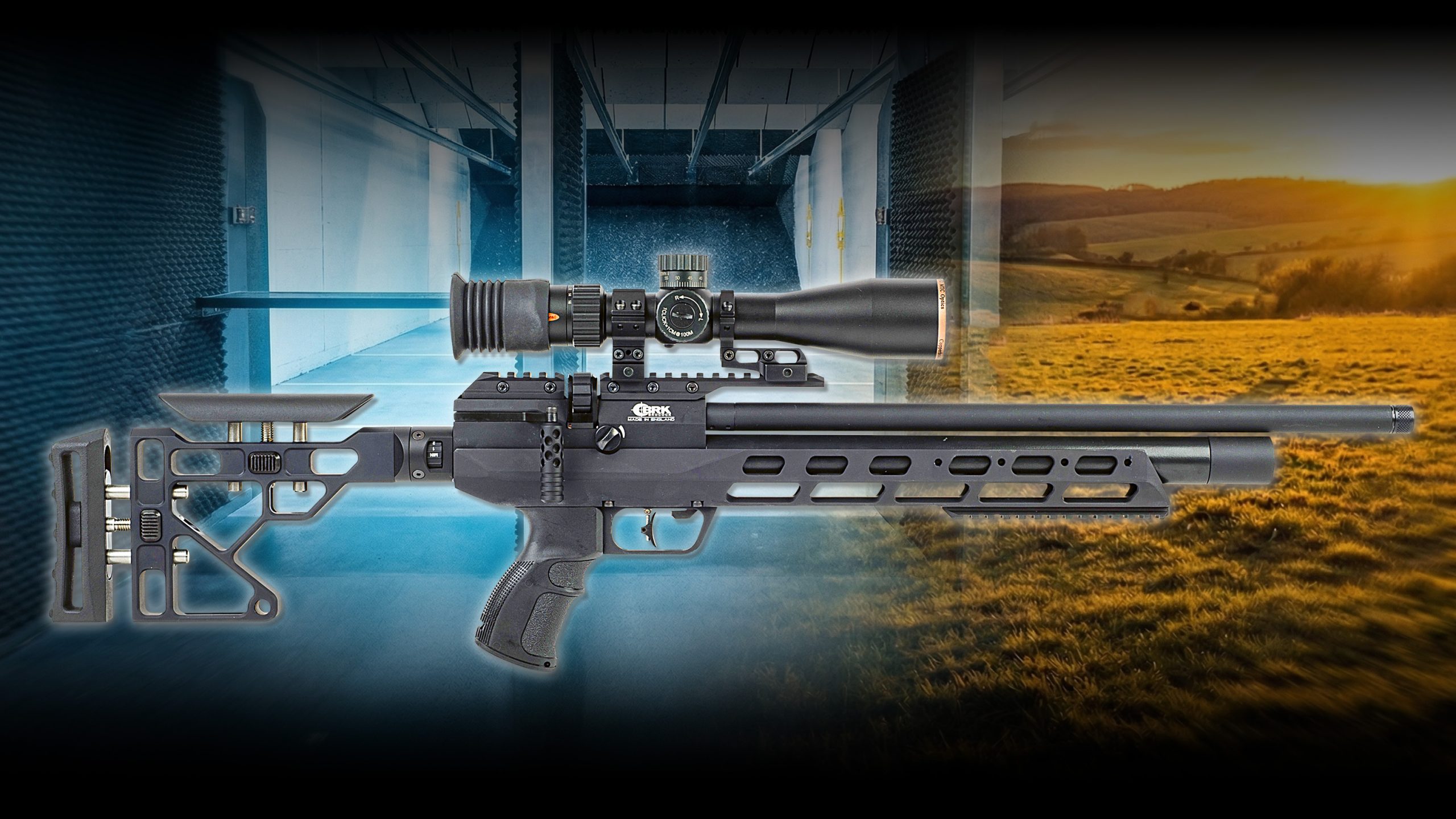
At £281 the MTC Optics Mamba Lite 4-16x42 is a budget-friendly air rifle scope that weighs 580g and comes with a host of features including a SCB2 reticle and 42mm diameter objective lens
At £639.95 the Pixfra Volans V850 LRF digital 4K day and night scope is a sizable investment but it more than repays it with strong performance and high-end features
Over the past 15 or so years, the evolution of “digital” riflescopes has been staggering; image quality has vastly improved and, lately, prices have fallen enough to make them a viable sighting device for airgunners.
Digital scopes give you an electronically captured image, rather than an optical one. I’d never taken one into the field before, but this month’s test subject has now really piqued my interest in them and then some.

Made by Pixfra and supplied by Thomas Jacks, my Volans 4K V850 LRF test sample will set you back £789.95, but it’s available without an integral laser rangefinder (LRF) for £639.95.
Yes, that’s a lot of money. However, the Volans 4K V850 is also a lot more than “just a scope”.
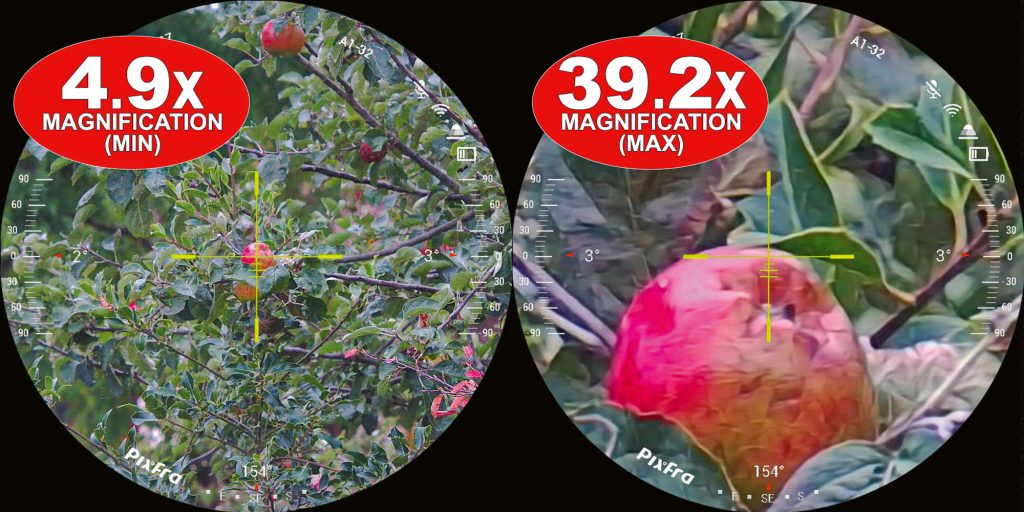
Not only can you zero it with a single shot, it “sees” in the dark, has a whopping magnification range of 4.9x to 39.2x and a choice of six reticles viewable in four colours. You can even video-record your shot… complete with audio if you should want it.
The astute among you will note the lack of conventional scope nomenclature. That’s because when it comes to digi-scopes, convention pretty much flies out of the window. Despite looking like a traditional optical telly and mounting with normal, 30mm ringmounts, the V850 swaps lenses for image sensors and turret adjusters for drop-down menus.

In the case of the Pixfra Volans, the image is captured on a Star Light CMOS sensor that renders the same level of detail as a high-end 4K television screen. The sensitivity of this sensor delivers a bright, sharp sight picture at light levels that not only a conventional scope couldn’t, but even your own eyes struggle with.
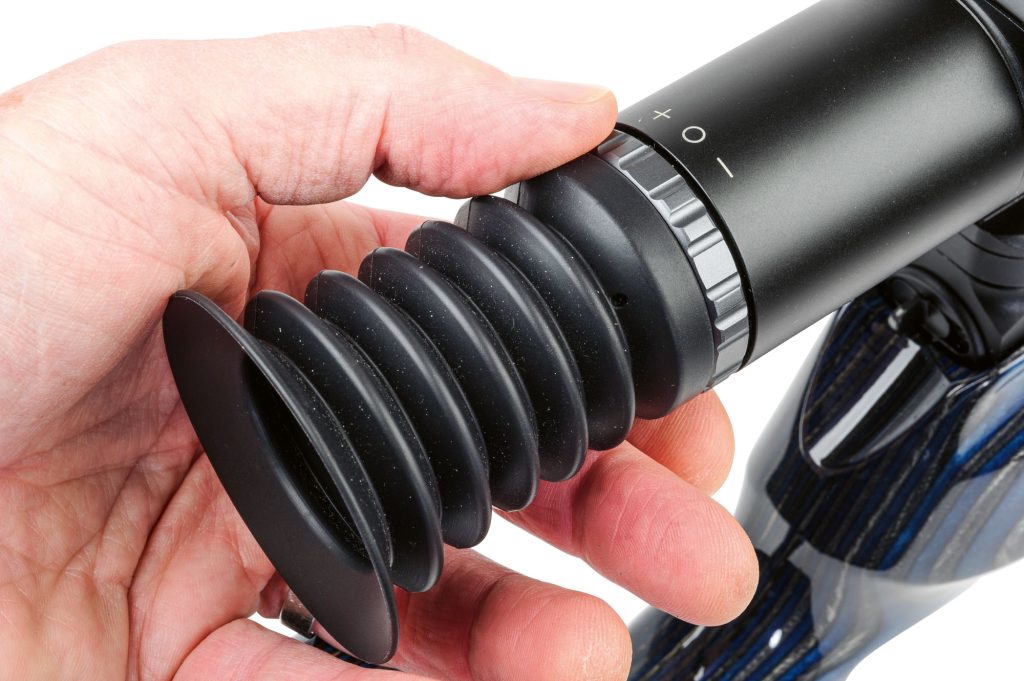
When you peer into the Volans’ “eye box” – its eyepiece – you see a 31mm diameter circular view that’s rendered in full colour at 800 pixels. A dioptre ring around the eyepiece lets you fine-focus this, while a soft rubber concertina eyecup ensures you get fully immersed into what you’re looking at.
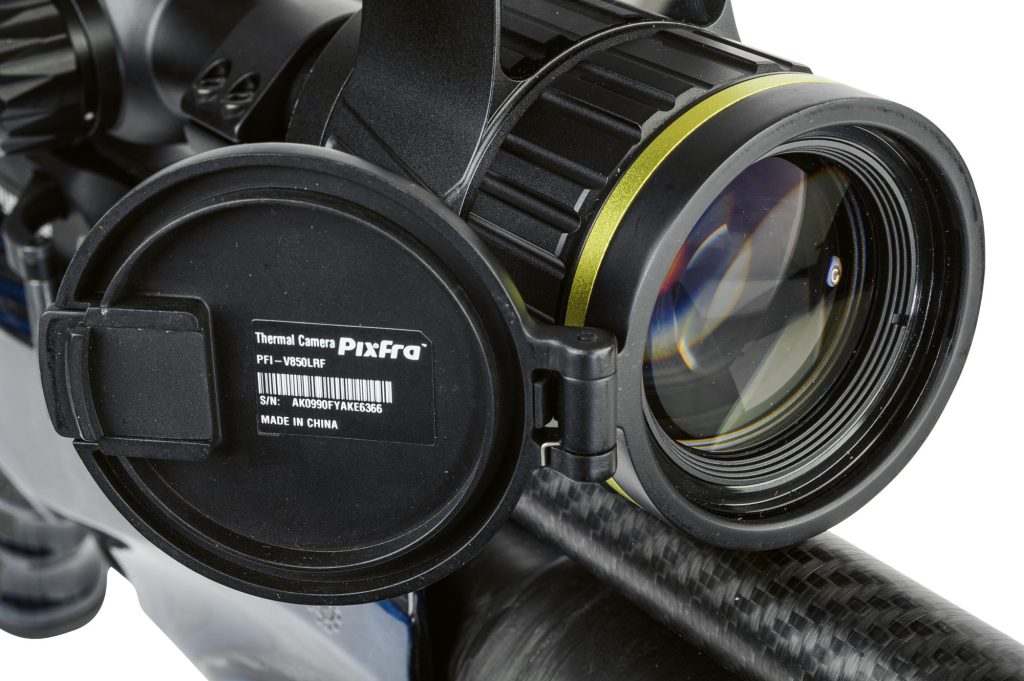
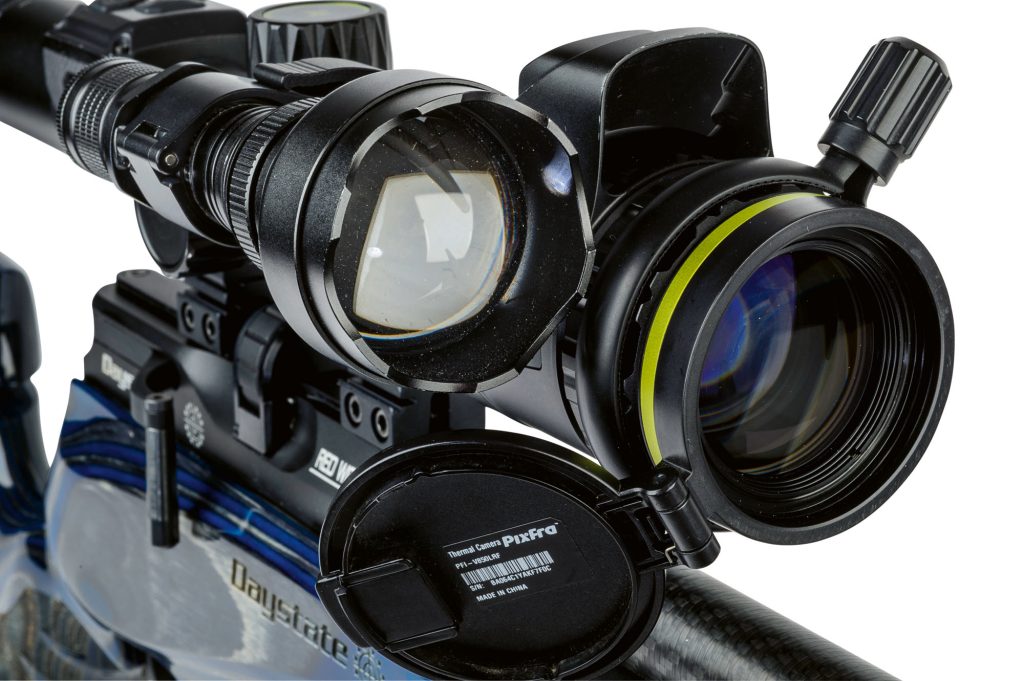
To view a scene, flip-open the sprung objective lens cover. On the LRF model, this needs positioning so that it doesn’t interfere with the laser module on top of the objective bell.
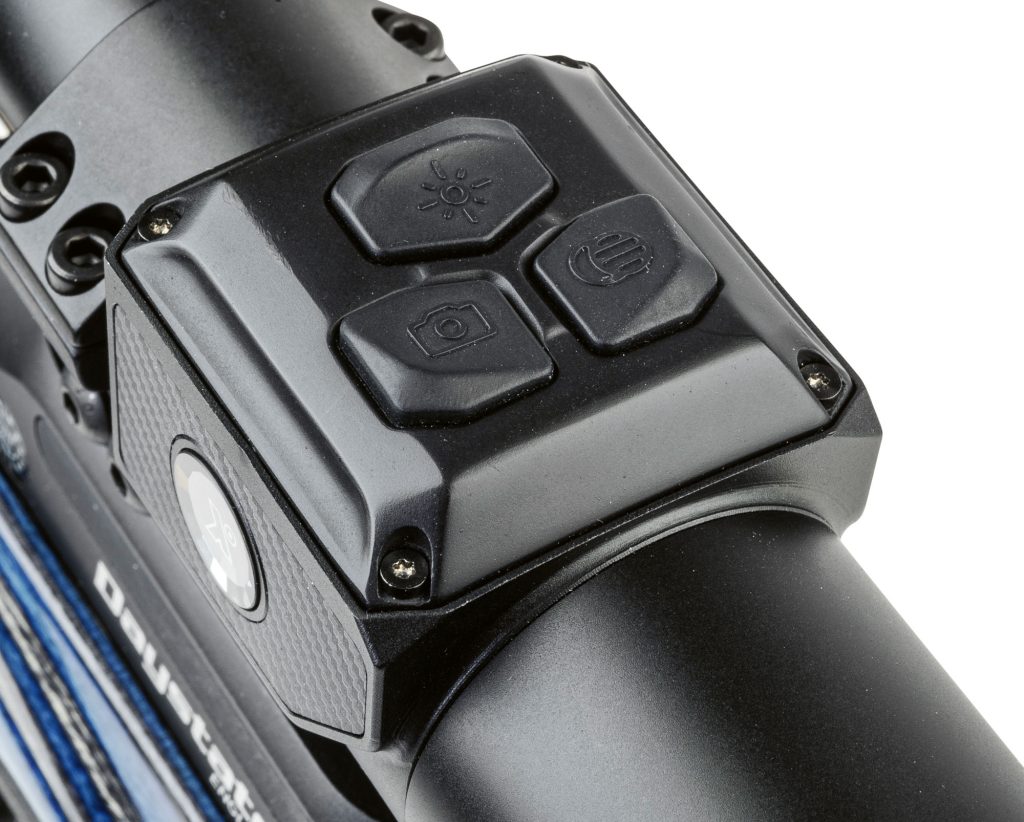
You then have options to view the scene according to the ambient lighting conditions, which you cycle through via the right push-button on top of the control module at the rear of the scope.

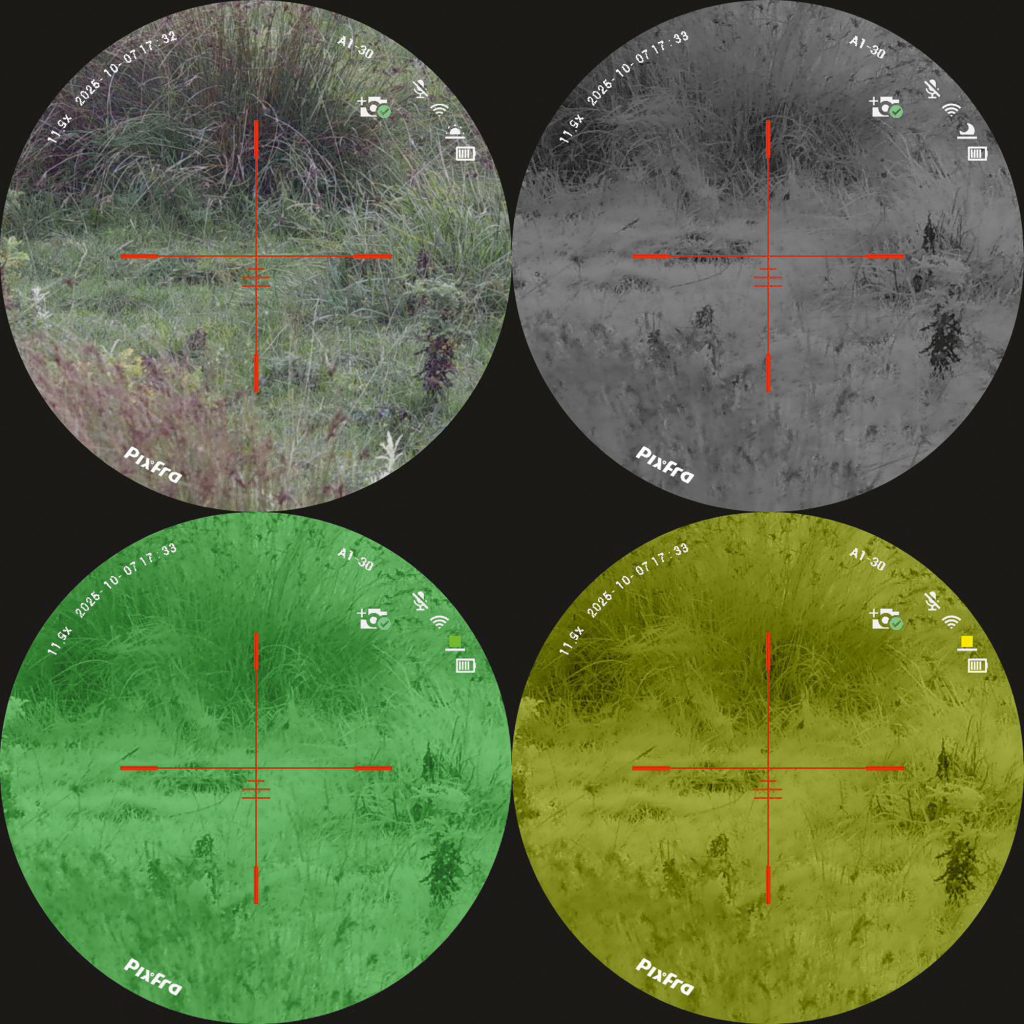
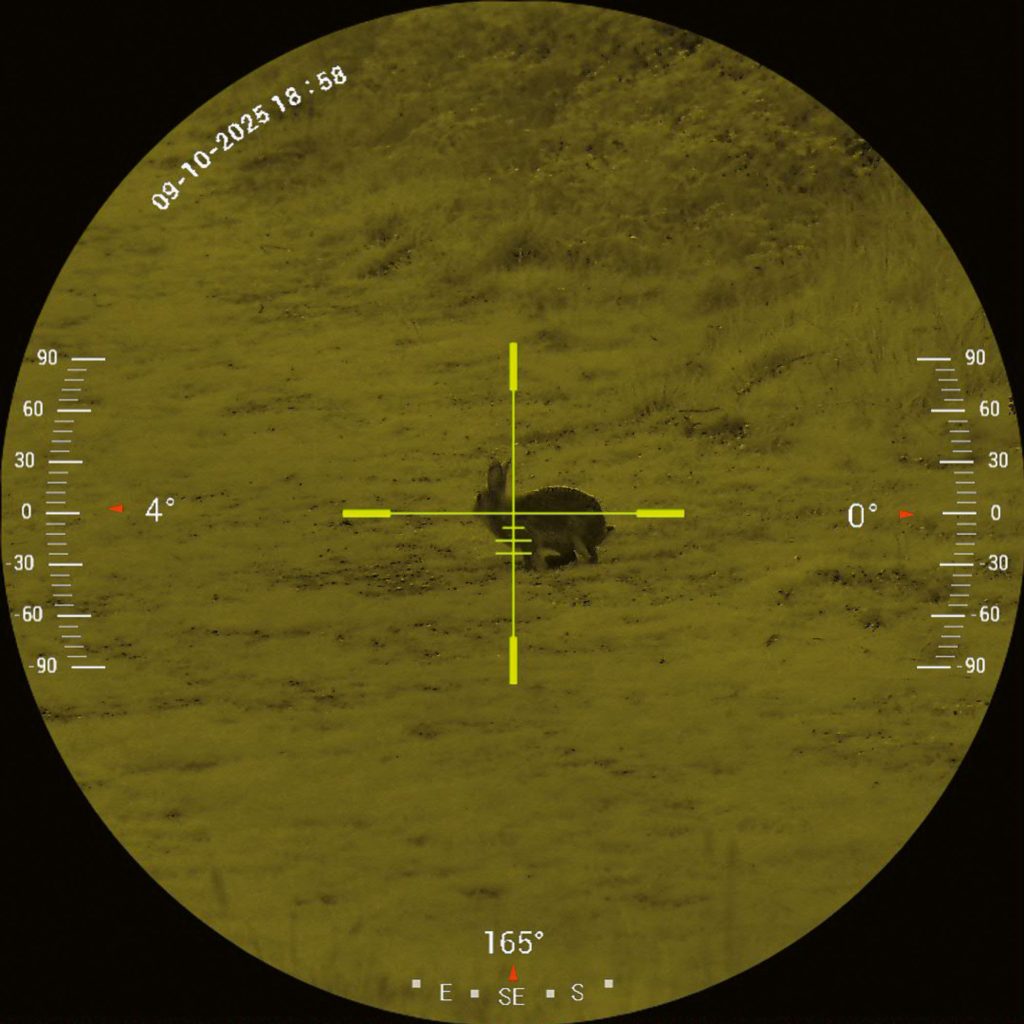
In the daytime, you’d choose the full colour option. This renders a very “natural” representation of the scene at a sharpness level as good as most optical scopes. When light levels fall, the V850’s night mode lets you view things in either black and white, or with green or yellow overlays to assist image contrast. The image you see will get “grainier” as the light drops off, but the scope’s sensor still renders an image that’s easily picked out.
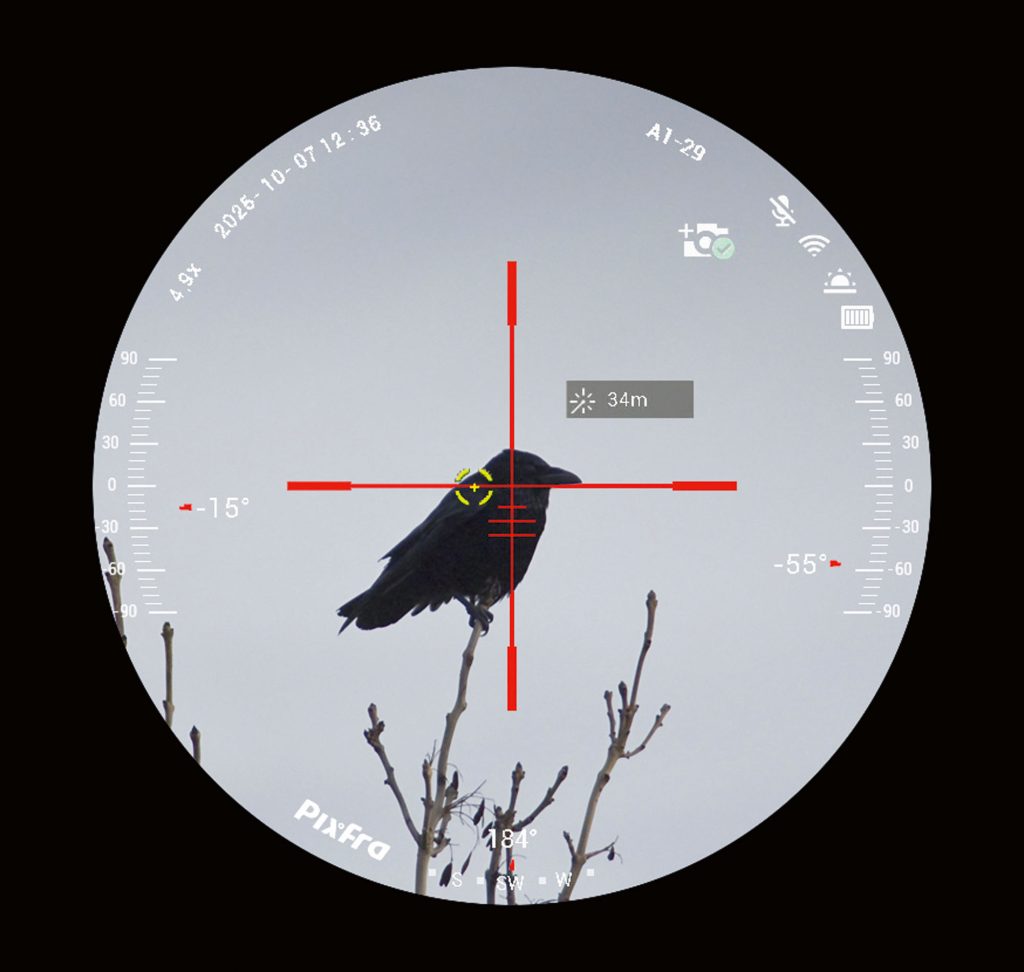
The left button on the control module’s top plate lets you capture the viewed image. Pressing it takes a photo (as you see on these pages); a longer press records a video of what you’re seeing in the eye-box. You can even set it so that a video automatically starts recording once it senses your rifle’s recoil, although this feature didn’t always work with my recoilless PCP.

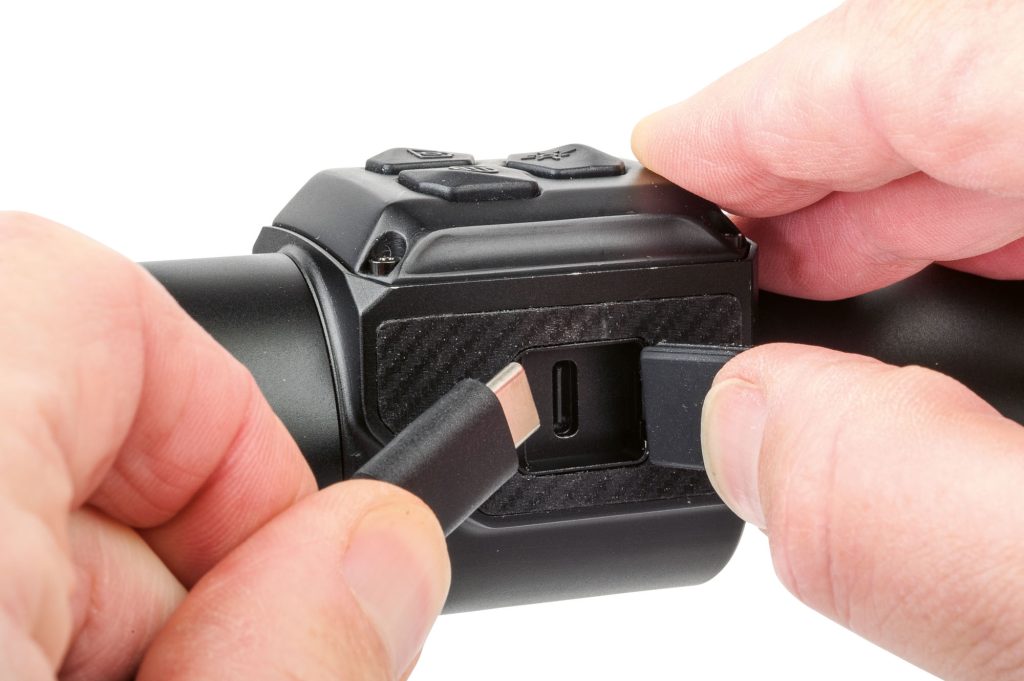
Photos and videos are uploaded to your computer device with a USB-C cable, the dust-protected port for which is on the right side of the control module. The Volans 4K records in .jpg (image) and .mp4 (video) file formats, so you can view them on all platforms without specialist software.
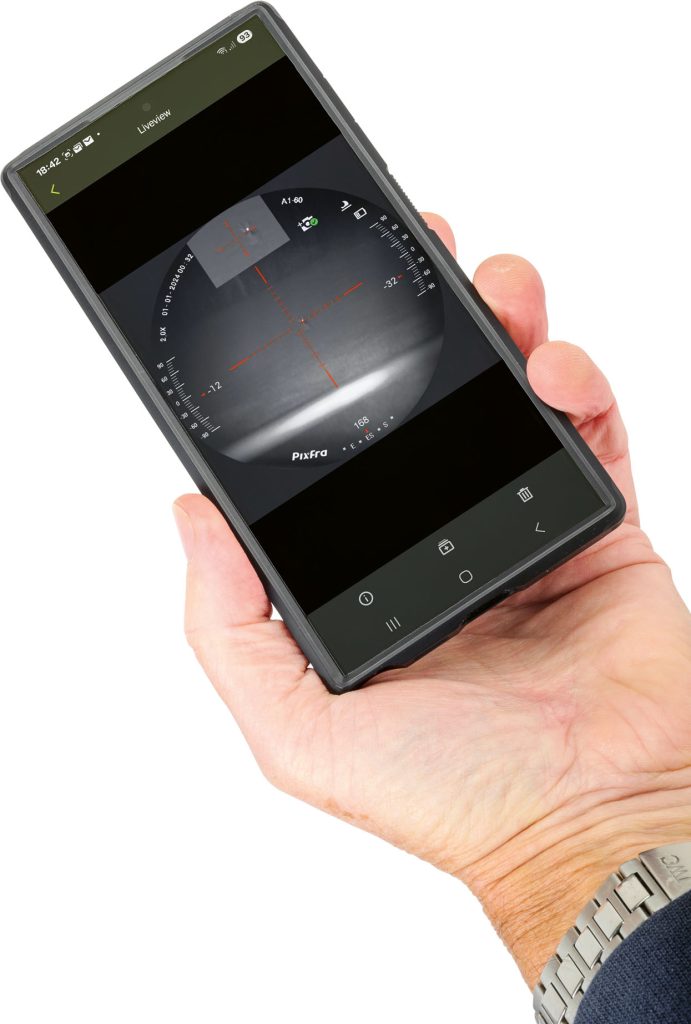
Additionally, the V850 has Wi-Fi built in, so you can link it to your smartphone with the free “Pixfra Outdoor” app available for iOS and Android. The app brings added functionality, including real-time mirroring on your phone’s screen of what is being viewed through the scope. This is cool if you night-shoot with a buddy – they can watch what you are seeing through the scope.

The front button on the top of the control module zaps the target with a laser, with the resulting distance – user-set to yards or meters – briefly overlaid in the viewfinder. Handy in the daytime, the LRF also works brilliantly in the dark, where estimating distances by eye is nigh-on impossible. Choosing the LRF version of the V850 is, in my opinion, the way to go.
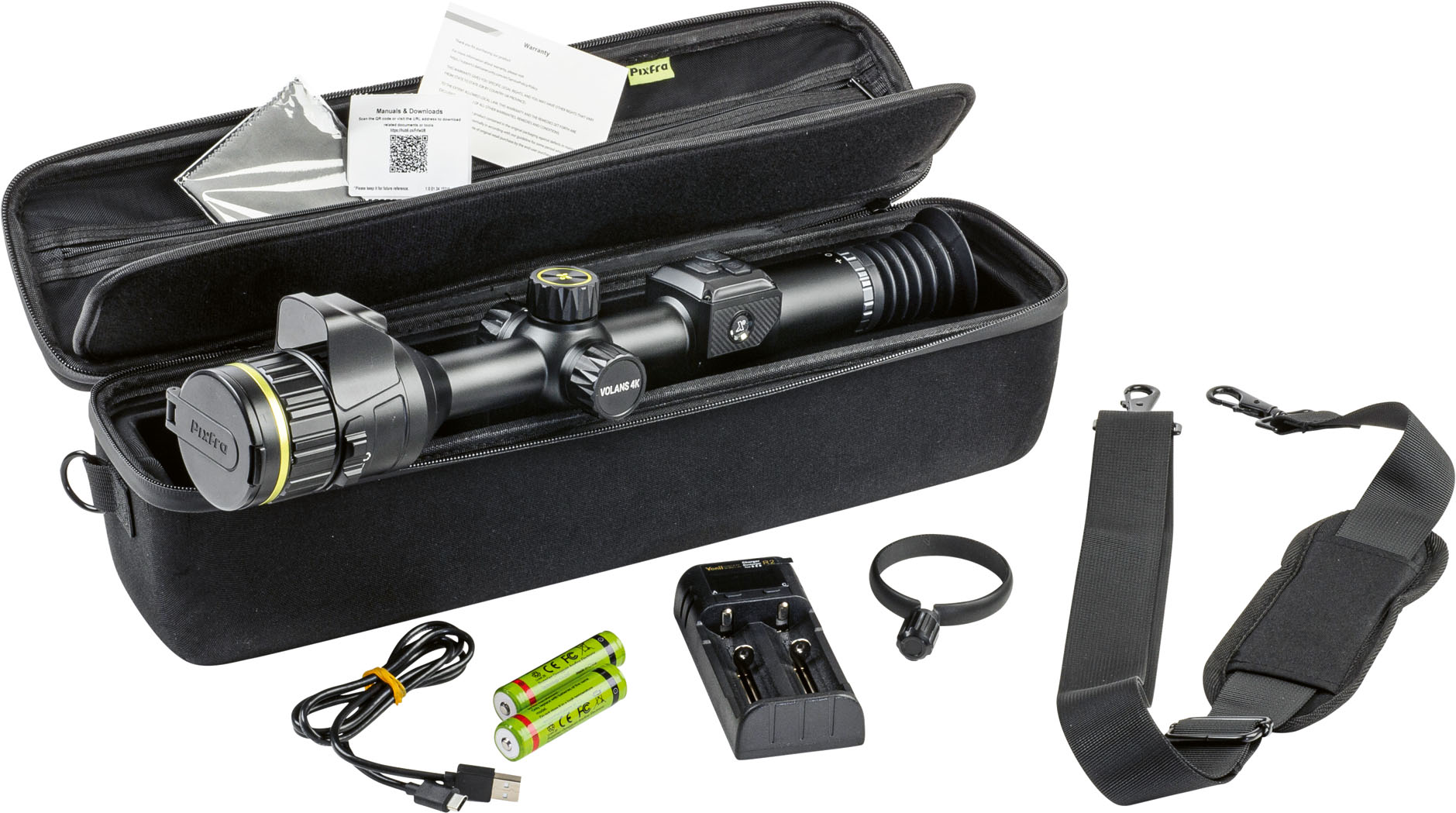
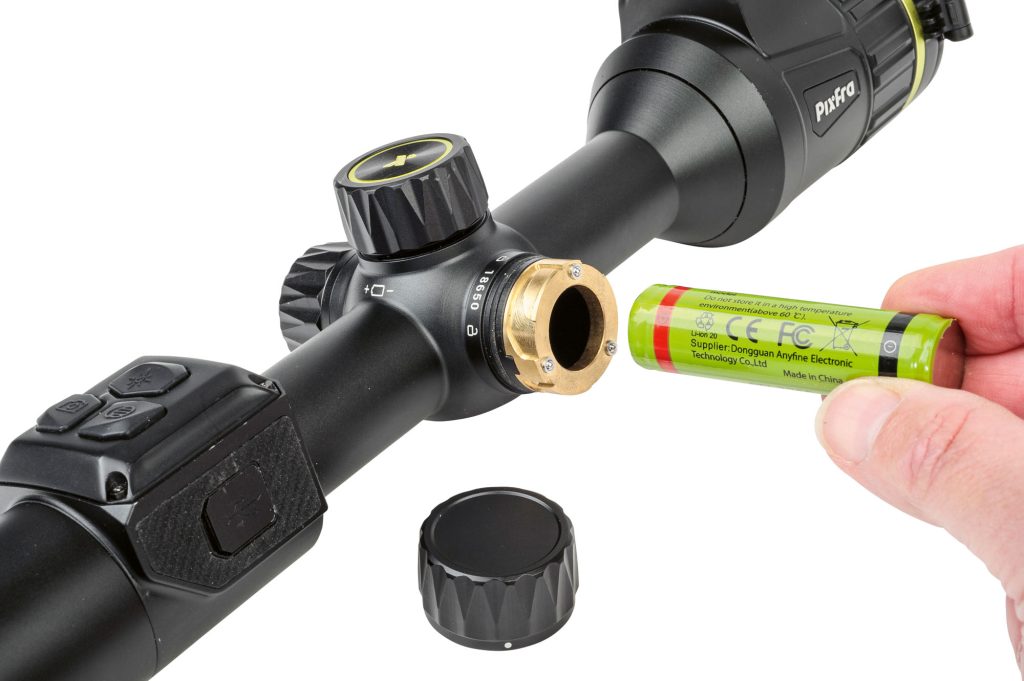
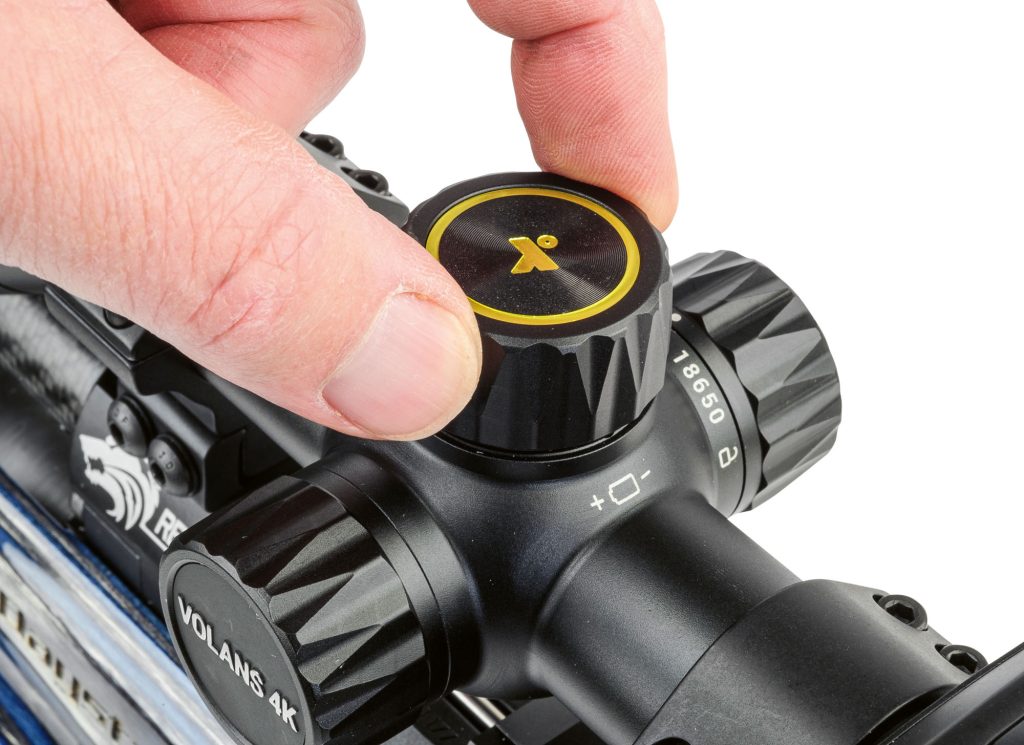
The push button on the left of the control module switches the scope on and off. Powered by one rechargeable Li-Ion 18650 battery located between the left and right “dummy” turrets , Pixfra claims up to 5.5 hours’ on time per charge. In practice, I rarely got more than 3.5 hours, especially on the colder nights. I never “ran out” of battery, though, and you get two batteries anyway. Plus a rather nifty charger, all contained in a neat semi-hardshell carry case. Via the USB-C cable, the battery can also be charged in situ.


While the buttons on the control module provide a quick-and-easy route for the scope’s features, the really deep-dive stuff comes courtesy of its top turret – the V850’s “command dial”.
It operates rather like a computer mouse: push it down for menus and rotate it to select functions within those menus. Rotating the turret without pressing it first zooms the magnification at increments you can tailor to your preference.

You certainly need to spend time familiarising yourself with the multitude of available menus. Actually, I’d highly recommend you “play” with the scope for some time before mounting it to a rifle if, like me, you’re new to digital scope technology. It’s not difficult to understand, but there is a steep learning curve because the V850 won’t be what you’re used to, scope-wise.

Take zeroing, for example. In a nutshell, you shoot a group – though one shot could be enough – from a rested rifle. Then you screengrab the sight image of the target and pellet hole/ group and, using the command dial, move a cursor to correspond with the group’s centre… and “save”. Job done! The coordinates are indexed, meaning your scope is zeroed.
You then assign a profile for your rifle/ pellet/ range and that can be recalled whenever you want. Within this profile, you have options to save up to six different reticle designs, in either black, red, white or green (which looks yellow to me). You can assign numerous profiles, all of which get stored in the scope’s 64Gb internal memory. This means you can switch ammunition and rifles and always have a setting to quickly return to.

But the Pixfra’s UI (user interface) goes further, offering a “Smart Ballistics” zeroing function. By inputting ballistic data, the scope will then work out how much aiming allowance is needed, based on your zero range in relation to the target’s distance established by the LRF. Cleverly, an additional aiming marker – the style of which you can choose yourself – is then overlaid on your reticle.
It’s genius, though probably more suited to bigger bore firearms and ultra-long distances than airgunning, and I switched the feature off. The reticles I selected gave me more than I needed for allowing hold-over in the conventional manner. Plus, I knew the target’s exact range courtesy of the LRF. I should also add that I found lasering to be metre-accurate in both the daylight and in the darkness.
There are too many functions on the V850 to go through them one-by-one. Suffice it to say, from cant and tilt angle to picture-in-picture display, you can customise the scope to your every day- and night-time shooting needs.

Pixfra supplies an online link to their latest user manual which you can store on your phone for instant reference, and they are committed to keeping the scope’s software up to date. Indeed, a firmware update became available midway through my tests and I noticed handy new features and improved operation as a result.
As a “first-timer”, what was my in-the-field experience like with this new-fangled scope technology? Well, digital is not a replacement for a conventional optical scope. Even at 4K resolution in the daylight, it’s a different visual experience. A lens-rendered image is more three-dimensional; one from a digital sensor is more 2D. It’s still good, though, and more than adequate for shooting with the kind of precision we airgunners need.
Where the digital Pixfra came into its own, though, was at ultra-low light levels. I was amazed at how long after sundown I could continue shooting. Same thing early doors – I was enjoying precise aiming on rabbits a good two hours before sunrise, even though I could barely make out hedgerows with the naked eye, let alone the bunnies.

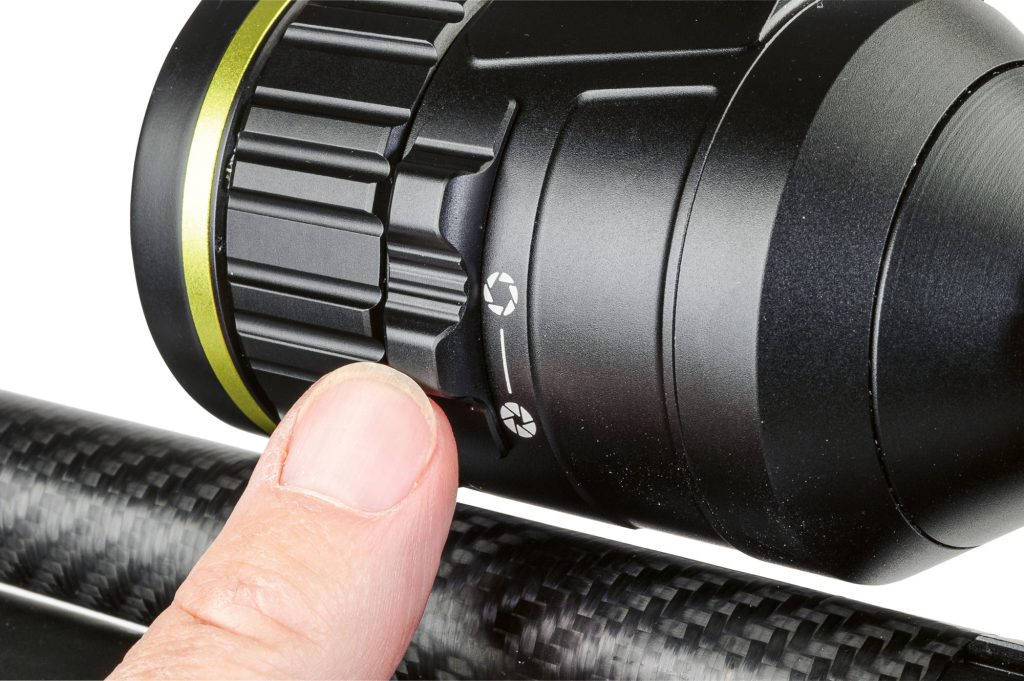
Pixfra states its V850’s objective lens is 50mm. I reckon this means focal length, though, because I measured the glass at 42mm diameter. Whatever, it includes an adjustable iris to boost the sight picture’s brightness. A glider on the left side of the objective bell lets you open (f1.2) or close (f3.0) this to suit the amount of light let in. I found this feature both extremely useful and ergonomic to operate.

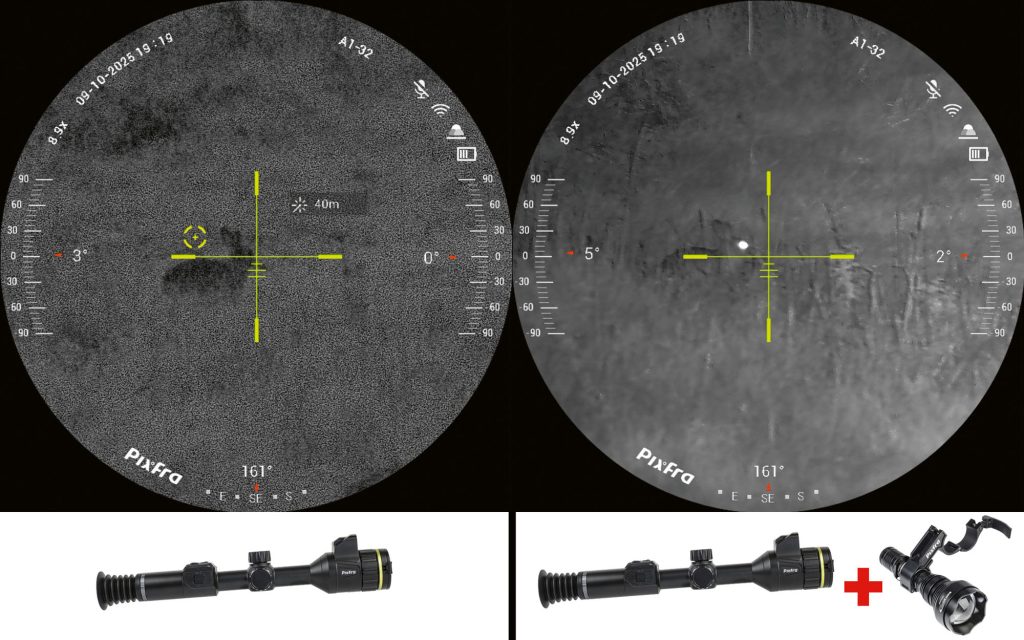
It was only when the sky was black, with minimal light from the moon and stars, that the V850 couldn’t render a target that I considered to be “safely shootable”. When I paired the scope with a Night Master NM1 SL infra-red (IR) light, I could use the scope on an airgun quarry around the clock.
While I could make out rabbits at airgun shooting distances in the darkness with the scope alone, the quality of the target improved dramatically when lit with the NM1 SL’s IR sight source. Rabbits’ eyes reflect like glass marbles when bathed in a pool of infra-red light, and this helped me “spot” distant rabbits that I otherwise wouldn’t have known were there. The tell-tale eye glow was clearly visible even when the rabbit wasn’t in focus.

Precise focus is achieved by rotating the objective’s knurled ring. In daylight, the system is fine, despite it sometimes being awkward to reach forward with one hand to fine-tune the image’s crispness. I’d therefore recommend using the throw lever collar that’s supplied with the scope, simply because it makes the focusing procedure less cumbersome. You may also need higher mounts to ensure that the collar doesn’t foul the receiver or barrel, too.
At night, I’d say the throw lever is essential. The grainier sight picture makes it fiddly to work out the point of best sharpness, but the lever lets you find it much more easily.
Also, even on its lowest magnification, the V850’s field of view is narrow. This makes it hard to spot rabbits when scanning the warrens in the dark unless you have a supplementary IR boost. With a grainy sight picture, rabbits and clumps of grass can look remarkably similar, especially if not in sharp focus.
I found the three night-mode scenes extremely useful from dusk right through to dark, selecting the one best-suited to my environment. Quickly choosing one with the Day/Night button on the control module was easy under field conditions, and speedier than going into the shortcut menu via a quick press of the command dial turret.

One thing I found I longed for was a quick way to change the colour of the reticle. The only way this can be done is to long-press the command dial to bring up the comprehensive menus, then rotate the turret to select the “Zeroing” menu. It’s quite time-consuming, so I hope that Pixfra considers adding the reticle colour as a shortcut feature in future firmware updates.
I converted to digital photography 25 years ago, so I’ve never been averse to digital technology in the riflescope arena. Nonetheless, it’s always been way too expensive for me to entertain, and somewhat behind the camera/ video world in my opinion.
However, I don’t mind admitting that the new Pixfra V850 LRF blew me away. I shan’t be pensioning off my airguns’ glassware any time soon, but I’ve realised I’ve now got to make room on a rifle for a digi-scope. And as for that old lamping kit of mine… well, I think it’s about to be handed its P45!
Make: Pixfra
Model: Volans V850 LRF (4K)
Sensor: CMOS 3840×2160 pixels (4K)
Objective lens: 50mm (quoted – 42mm measured), with adjustable aperture (f1.2 to f3.0)
Tube: 30mm
Magnification: 4.9x “base”, digitally adjustable to 39.2x with auto-level brightness
Reticle: Choice of six in black, white, red or green
View modes: Colour, night (b&w), green and yellow
Primary focus: 5m to infinity (via objective collar)
Dioptre focus: +/- 3.0. Eyepiece includes concertina eyecup
Viewfinder display: 1.25in circular LCD with 800x800px resolution
Eye relief: 70mm
Recording: Video (with audio) at 50Hz (.mp4 format); Still image (.jpg format). Video can be auto-started on recoil. Scope image display can be live-tethered to smartphone via free Pixfra Outdoor app (available on iOS/ Android)
Internal memory: 64Gb storage
Laser rangefinder: Effective from 10m up to 1,800m. 1% accuracy. (Detection subject to image conditions)
Battery: Rechargeable Li-on 18650 (x1) 3200mAh. Up to 5.5 hours’ use per charge. Battery can be charged on- and off-board
Interface: USB-C (power and data)
User interface: Includes ballistic calculator, “one-shot” zero-setting, picture-in-picture (PIP) display, Wi-Fi
Waterproof: Rated IP67
Shockproof: Rated up to 6,000J
Length: 435mm
Weight: 1,084g excl. mounts
Supplied with: Carry case with shoulder strap, detachable focus throw lever, x2 batteries, battery charger, USB-C data/power cable, lens cloth, QR code link to user manuals, three-year warranty
SRP: £789.95 for model tested. (£639.95 for non-LRF model)