

PAO HD MAX Ultra Compact riflescope review
The PAO HD MAX Ultra Compact is a game-changing 4-16x FFP optic that packs high-definition glass and a 44mm objective into a class-leading 23.1cm, 420g frame. Featuring a unique three-yard minimum par...
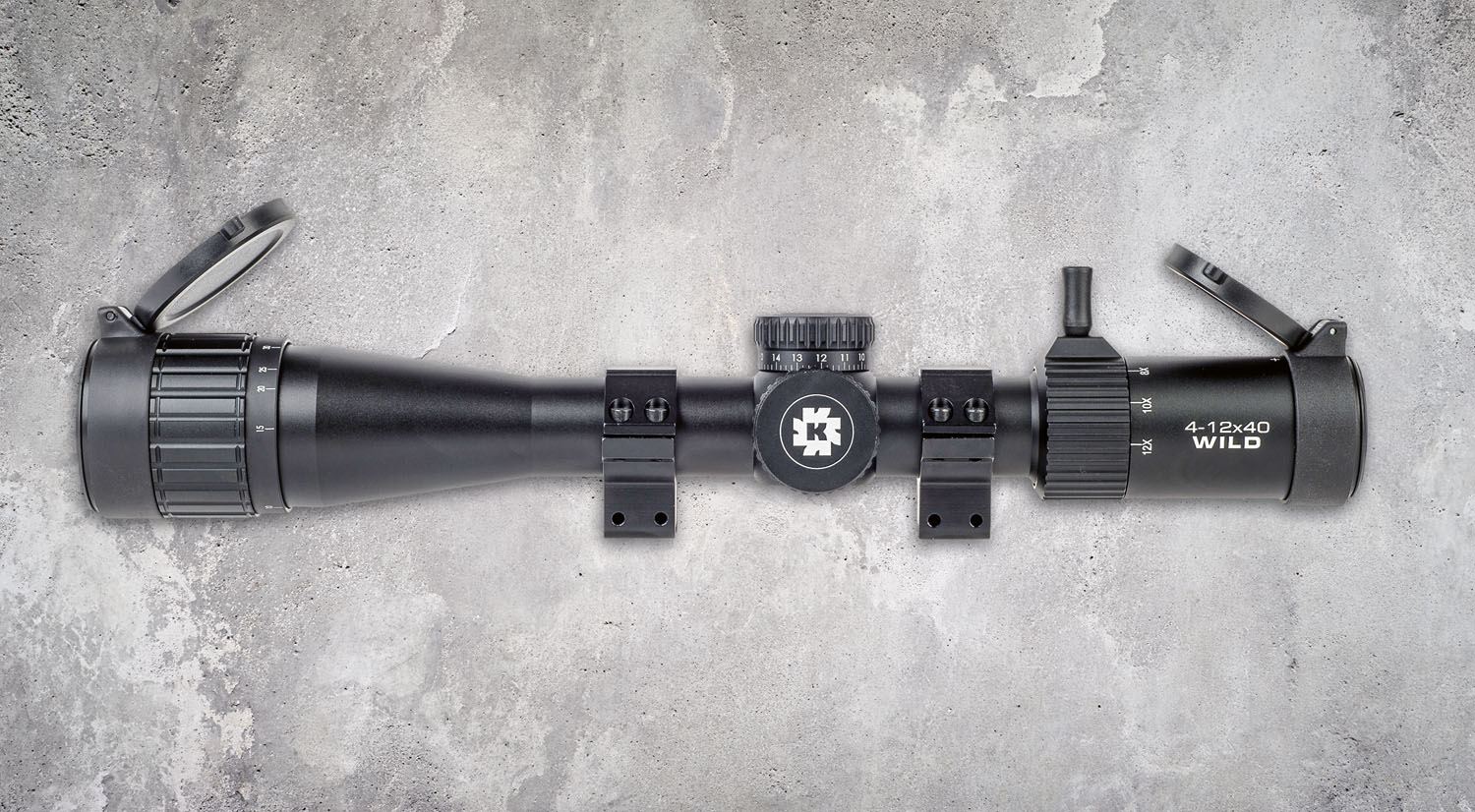
Discover why the Konus Wild 4-12x40 is 2026’s biggest bargain, offering illuminated optics and locking turrets for under £100
Konus is a relatively new scope brand to us airgunners, though that’s likely to change now it’s supplied to UK gun shops by distribution giants, Range Right. My first experience with a Konus was the 2-16×50 Glory, a flagship model reviewed in the April 2025 issue of Airgun World. It impressed me, as a scope costing £550 probably should! So, when I was sent the Konus 4-12×40 Wild model, I wasn’t sure what to expect.
This one’s £90 price tag suggested a cheap ‘n’ cheerful optic that would be a far cry from Glory. I mean, besides its healthy 4x to 12x magnification range and a 30mm tube, you also get mounts thrown in. And on top of that, the Konus Wild boasts a dual-colour, multi-brightness illuminated reticle, adjustable parallax, push/ pull locking turrets, a zoom throw-lever and flip-up lens covers.
There’s an adage that if a deal sounds too good to be true, it probably is. Not in the case of this Konus, though. Before I get started, let me issue a spoiler alert: this is the best “budget priced” scope I’ve ever tested.
Despite my very positive experience with the Glory, I had little expectation of a £90 scope with such a long list of specifications from an unfamiliar brand. Who wouldn’t? However, unboxing the Wild from its lack-lustre packaging, I was immediately surprised at the build quality. Nicely engineered, its anti-reflective matt black finish is impeccable. Its bold, white graphics look expensive, and the zoom ring, turrets and adjustable objective all turn with the feel of a far more expensive optic.
Then I looked through it: wow! The sight picture the Wild renders through its multi-coated 40mm diameter objective is truly incredible. Colour and sharpness match that of many a scope costing upwards of £250, with no colour fringing or “ghosting” at any magnification. I actually called Range Right to double-check the price; yep – £90 retail. (And just as an aside, the new 3-9×40 Wild model that’s also joining the line-up is even cheaper at £70).
My test scope carried on delivering once I got it out into the fields and on the range. Initially, I used the two-piece ringmounts supplied in the box to fit it to a Weihrauch HW35E springer. One of these mounts feature a retractable stop-pin. Used at the rear, it means you can anchor the scope against recoil slippage by locating it into one of the HW’s receiver holes. Not only did the mounts hold the scope true, but when I “walked the zero” on a test target – 60 clicks Up, Right, Down and then Left – the group returned to the original point of impact setting.
Even when it was too cold to go gloveless, the objective bell’s parallax collar turned without any stiffness, which can be a problem on some scopes. I found the magnification ring a little stiffer, but having a screw-in throw lever helped immensely when zooming through the powers. For reference, the magnification setting is slightly different from the norm in that the pointer is on the ring itself, with the power settings fixed on the eyepiece.
As for image brightness, even at the higher powers, the 40mm diameter, coated objective lens and 30mm body tube returned a sight picture that was as clear as you could ever wish for. And, of course, the Wild’s illuminated reticle further aided precision aiming. Powered by a CR2032 battery accessible via the screw-off cap on the left-hand turret, the Wild’s etched reticle can be illuminated to one of five intensity levels in either red or green.
Konus dubs the Wild’s reticle as “Mil-Dot” because it’s been designed around milliradian spacing. This is slightly misleading because being in the second focal plane (SFP), the MIL system only has relevance at 10x magnification. Also, there aren’t that many dots, with the majority of aiming reference points being made up of small graduations. Not that it’s a problem. Indeed, I found the reticle extremely practical. It doesn’t clutter the sight picture and offers plenty of aimpoints for airgunners.
The Konus Wild has finger-operable elevation and windage turrets, so you can “dial-in” a dead-on zero to suit the distance you’re shooting over. Each turret is lockable – pull to unlock, push to lock – and both verniers are resettable to “0” once you’ve synched your rifle, ammo and preferred zero distance. Konus even throws in a special tool to slacken off the turrets’ vernier drums, which then lets you “free-spin” them into position.
The important point here is that this Konus lets you remove any aiming errors caused by parallax, which is particularly problematic when shooting at close ranges. The vernier on the AO collar is well marked for airgunners – 10, 15, 20, 25, 30 and 50 yards being the most relevant reference points. Incidentally, the minimum parallax setting is around eight yards – great if you use this scope for a bit of back garden plinking.
Primary focus is obtained at the eyepiece. Here, again, the Konus punches well above its weight as there’s a quick-focus ring with plenty of dioptre adjustment. I wear spectacles but prefer to shoot without them, so getting both the target image and crosshair into focus is often tricky. There was so much adjustment on the Konus, though, that I could shoot either with or without my glasses on.
The truth is, I really enjoyed shooting rifles with the Konus on board. Partly because I was just so gobsmacked at its performance-to-price ratio, but mainly because it is just a very good scope. While the £550 Konus Glory impressed me, the £90 Wild knocked me over with a feather. If you’re in the market for a new scope, this could well be the biggest bargain of the year.
The Konus Wild’s turret click is 1/4MOA (minute of angle). Many airgunners prefer these over 0.1MRAD (milliradian) turrets because they allow for a more precise zero thanks to their finer click adjustments. One 1/4MOA click moves the pellet’s point of impact (POI) by 1/4in (6.35mm) at 100 yards, whereas as one 0.1MRAD click moves the POI 10mm at 100 metres.
Translated to airgun distances, this means one click of a 1/4MOA turret moves the POI 1/16in (1.6mm) at 25 yards. On the other hand, one click of a 0.1MRAD turret moves the POI 2.5mm at 25 metres, which is the equivalent of 2.3mm at 25 yards.
These may seem small differences, but that’s what matters if you’re after a super-precise zero!
Close one eye, then point your finger to, say, a tree in the distance. Now, open the shut eye, and close the open one; your finger will no longer be pointing at the tree.
This is a good analogy for parallax which, in scope terms, is the error that can happen between the target and the crosshair should you align your eye down the eyepiece differently from one shot to the next. Effectively, the crosshair moves all around the target according to how you’re looking through the scope, even if your hold is rock-steady.
However, by setting the scope’s parallax to the exact distance you’re shooting over, any of these potential aiming errors are eliminated. No matter how you align your eye, the crosshairs will always be bang on.
Optical performance is carried out at 25m in typical daylight conditions, viewing newspaper print at low, mid and high magnifications. Scores achieved (in red graphic) are rated as absolute results. The black graphics indicate the reviewer’s expectations, based on retail price and brand. Expectation levels will be greater for higher priced scopes from well-known brands, and lower for cheaper scopes from less well-known brands.
Get the latest news delivered direct to your door