Home/Hawke Vantage 30 4-16×50 SF riflescope review
Optics product reviews
Hawke Vantage 30 4-16×50 SF riflescope review
The Hawke Vantage 30 4-16x50 SF delivers exceptional clarity and mechanical reliability. Meet a versatile, cost-effective optic that is essential for serious airgunners
Nigel Allen22 April 2026
Hawke is a dominant brand in the telescopic sight world, and its Vantage 30 range is a firm favourite with airgunners. This is why the latest 4-16×50 side focus addition caught my eye, and not least because of its affordable £279 price tag.
It comes in two versions – metric or “old school”. Those who like the more modern MRAD turret adjustment get a multi-stadia Mil Pro II reticle with red-illuminable centre. Shooters who prefer their scope with traditional 1/4MOA turrets get the less complicated LR2 Dot (16x) crosshair, with a red/ green illuminable centre dot. Both reticles are positioned in the sight’s second focal plane.
LR2 Dot vs. Mil Pro II: which reticle should you choose?
As I favour the extra precision that minute-of-angle “clicks” offer over MILs, I opted for the LR2 Dot model. For me, its less busy crosshair design makes it more practical in airgunning applications. It may have been designed with centrefire calibres in mind and look quite “bare” next to the Mil Pro II, but it’s actually got more going for it than may appear at first glance. I therefore make no apologies for diving a little deeper into its layout in this review. First, however, let’s look at the scope’s other features.
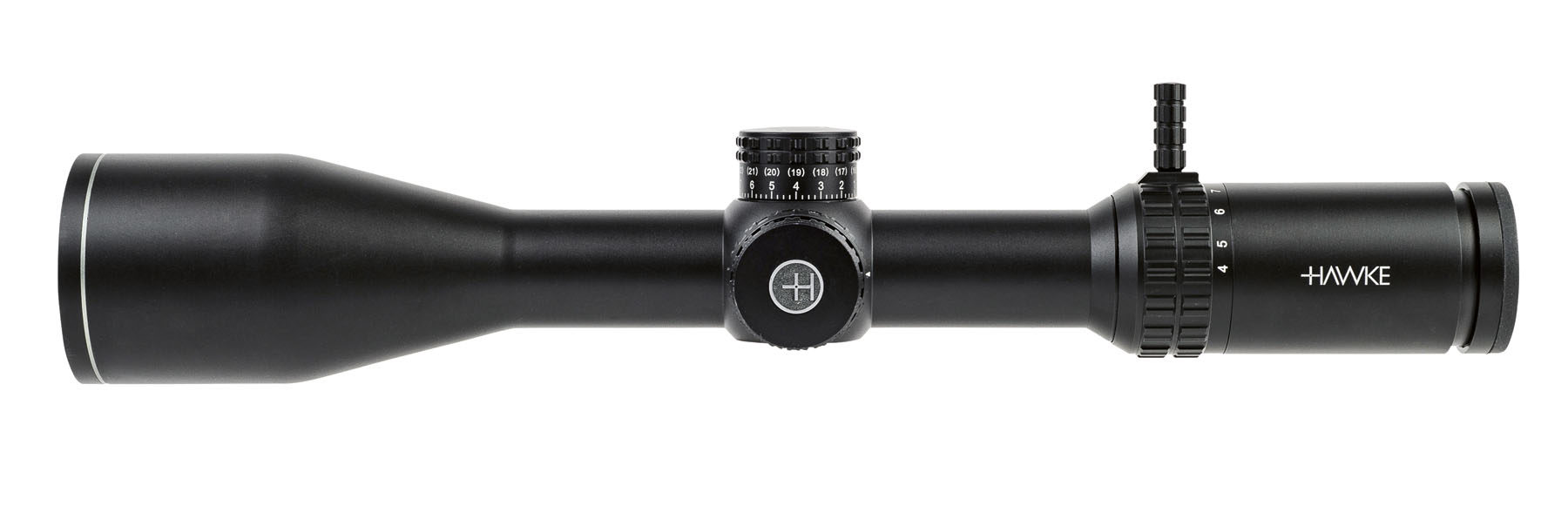
From the get-go, Hawke’s packaging inspires you with confidence. Unboxing any Hawke riflescope is a wonderful experience and sets the tone of what’s to come. The 4-16×50 Vantage 30 is beautifully presented; solidly built with an absolutely flawless anti-reflective matt black finish and bold white graphics.
How does the Hawke H2 optical system perform in low light?
That look of quality also translates to the workings. I always have high expectations of any Hawke model. They box above their weight in terms of optical performance versus price, and this new Vantage 30 is no exception.
The clarity of the sight picture comes down to two things. First and most obviously, this scope’s 50mm diameter objective lens sucks in every morsel of available light. Secondly, Hawke’s System H2 optical system maximises light transmission through the scope via its 11-layer, multicoated lenses.
Once I began my in-the-field tests, I was gobsmacked at how bright an image this new Vantage 30 renders. It handled all scenarios with aplomb: dawn, dusk, open field and dark woodlands. There were only a few occasions – usually harsh side-lighting – where I felt the sight picture got a bit “milky”. The scope doesn’t come with any sunshade to assist in such conditions, but a screw-on tube and diffuser are available as optional extras.
What mounts do I need for a Hawke 4-16×50 scope?
As with many higher end scopes, it’s supplied without mounts, so you’ll need to choose a set to match you and your rifle’s needs. Just remember that you’ll require oversize rings for its 30mm body tube which, surprisingly for a sub-£300 scope, is also the much stronger monocoque type. Also, they may have to be the high variety to ensure the front bell doesn’t foul the receiver.
Included in the box are elasticated “see-thru” lens covers. These are decent enough quality through which to scan a target area, but precise aiming will require their removal. Far more practical, though, is the 22mm long zoom throw lever. Even when wearing shooting mitts, it helps you turn through the magnification range with speed and minimal effort. I love these levers, but some shooters find the lever can snag on clothing. No worries, you can unscrew these. What’s more, Hawke even supplies a blanking plug for the resulting hole… along with the required hex tool!
How accurate is the Hawke Vantage 30 side focus for range-finding?
The “SF” suffix in this scope’s moniker stands for Side Focus, referencing the Vantage 30’s sidewheel parallax adjustment (P/A) that eliminates aiming issues caused by parallax error from infinity down to 10 yards.
Dialling out the error fine-focuses the sight picture, too, which can act as a secondary aid in confirming the target’s distance when you’re shooting over unknown terrain. It’s best to use it as such with the scope on full, 16x magnification. Simply turn the P/A sidewheel to get the target in focus and then read off the range marked on the sidewheel.
For airgunners, this scope’s vernier has yardages marked for 10, 15, 20, 30 and 50. There’s decent space between these reference points, too and I could range-find with surprising accuracy at full magnification. Hawke offers an optional 100mm diameter sidewheel for this model which I’d recommend if accurate range-finding is important to you.
How do the locking turrets work on the Hawke Vantage 30?
You’ll need to set the scope’s primary focus for you, whereby you set the ocular lens to render the reticle at its sharpest. The eyepiece’s quick-turn focus ring offers plenty of dioptre adjustment and I could set it to suit my preference of shooting with or without my prescription glasses. Zeroing-up the scope is also an easy affair.
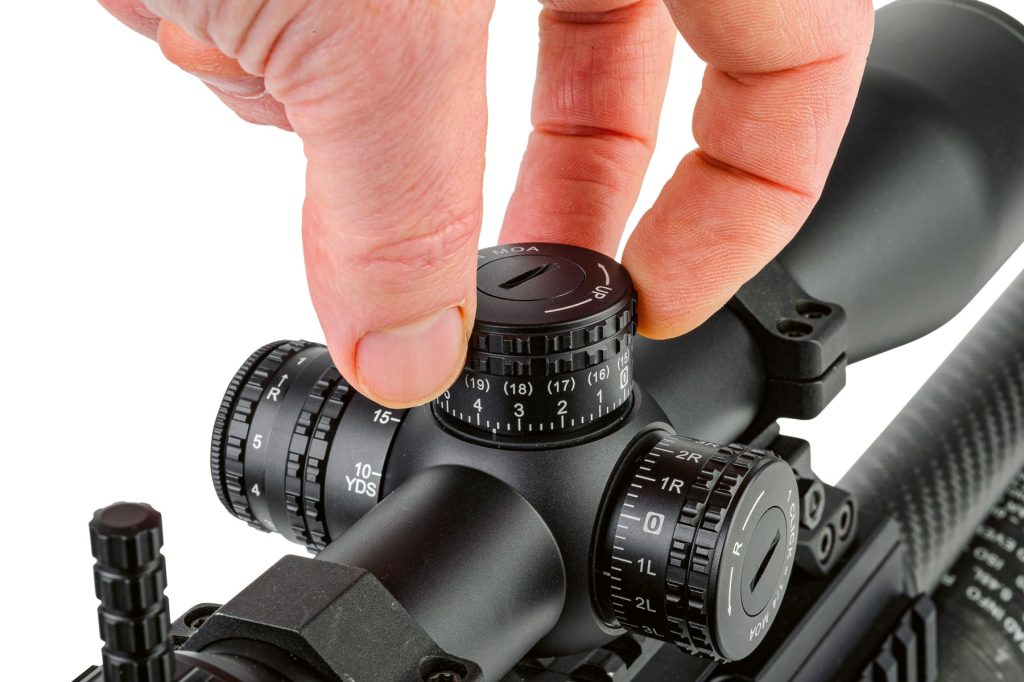
The Vantage 30’s elevation and windage turrets are external, with a system that lets you lock them against inadvertent adjustment. Pull out to turn; push in to lock. On my test model, each click alters the point of impact (POI) in 1/4MOA increments. That’s the equivalent of a quarter-inch (6.35mm) at 100 yards, an eighth (3.2mm) at 50 yards, a sixteenth (1.6mm) at 25 yards and so on.
Because this is much finer than the 10mm POI adjusted by a MRAD turret (at 100 metres; 5mm at 50), you’ll have no issues getting a pin-point zero. Additionally, each turret has a total range of 380 clicks, with 60 clicks per turret revolution. Once you’ve zeroed, you can set each turret to its “0” mark by slackening off the top locking cap with either the tool Hawke provides or a coin, free-spinning the drum into position and retightening the cap.
How does the LR2 dot illuminated reticle perform in the field?
The only slight moan I have with the adjusters is that there’s no reference marker on the scope body – you have to unlock the turret drum to see it. However, because the Vantage 30 is “all recoil rated”, you can be confident that your zero will hold firm even on the most violent of spring-powered hardware. I was also pleased to see that all the turrets were well sealed with O-ring gaskets to prevent moisture and dirt ingress.
The subtend design of the LR2 Dot reticle is discussed in-depth separately. However, it’s worth noting that its central black dot can be illuminated in either red or green to best suit the target. Controlled from the outer dial of the scope’s left-hand turret, each colour offers five intensities.
The supplied CR2032 battery used to power the IR – Illuminated Reticle – feature is located within the rheostat turret. Because the LR2 Dot’s glass-etched reticle is so fine, I used the IR a lot, particularly on the higher brightness values.
As an airgunner, I was extremely happy with the crosshair’s overall design. Unlike many of today’s scopes, the LR2 Dot’s layout is easy to navigate in the heat of the moment. Hunters will especially appreciate this because you don’t lose valuable time trying to fathom out what aimpoint to use when you’re lining up on a skittish target.
Furthermore, the thicker outer bars are wide-set and with no thick post above the crosshair to mask anything important, you get a pleasantly “full” sight picture. The fact it’s all so sharp due to the Hawke’s H2 Optical System is icing on the cake.
If you view a telescopic sight as being absolutely essential for precision air rifle shooting then the new Vantage 30 4-16×50 SF LR2 Dot should most certainly be on your shortlist.
The SFP sight picture
Regardless of whether you opt for the LR2 Dot (tested) or Mil Pro II reticle in Hawke’s new 4-16×50 SF Vantage 30 model, it’s situated in its second focal plane. This is referred to as an SFP crosshair. As you zoom through the magnification range, the size of the target will increase or decrease, but the size of the crosshair won’t.
To put this another way, the relationship between the target and the subtends on the reticle will change according to the magnification at which you’re viewing. This is important to remember if you use the subtends on the lower stadia for “hold-over” when allowing for trajectory drop-off at targets further than your zero distance.
When working out your pellet’s trajectory in relation to the subtends at different distances, you should always shoot with the scope set on exactly the same magnification that you like to generally shoot on. Were you to work out your holdover points with the scope set at, say 16x power, but then lower it to 8x, the point of impact and subtends would no longer marry up.
In depth: the LR2 Dot (16x) reticle
This new, glass-etched reticle design of Hawke’s proves that airgunners don’t need a crosshair that looks like a sheet of graph paper! Even though there are just a few subtends on the lower quadrant’s vertical stadia, the LR2 Dot’s lacks nothing from an airgunner’s perspective.
Hawke provides data for its MOA subtend spacings, although being a second focal plane scope, it applies only when the scope is set to 16x magnification. By transposing the MOA figures to their equivalent “click” values (shown in darker blue), you can then gauge the POI “drop” between the subtends at varying distances.
For example, the distance between the central dot and the second horizontal subtend is 7.1MOA, equivalent to 28 clicks of the elevation turret. At 15 yards, this gap would represent a trajectory drop of 28mm (1mm POI click multiplied by 28 clicks). At 40 yards though, the drop-off would be 70mm (2.5mm x 28) – and at 50 yards, it would measure up at 90mm (3.2mm x 28).
Of course, you don’t need to take such a mathematical approach: you can simply use the LR2 Dot as a conventional ladder reticle. For both .177 and .22 calibre sub-12ft/lb airguns, it’s extremely practical.
Technical Specifications
Hawke Vantage 30 4-16×50 SF
Make:
Hawke Optics
Model:
4-16×50 SF Vantage 30
Magnification:
Variable, 4x to 16x (stepless)
Objective:
50mm diameter
Optical System:
System H2 glass, fully multi-coated (11 layers)
Tube Diameter:
30mm monotube
Reticle:
LR2 Dot (16x) – glass-etched, second focal plane
Illumination:
Red/ green illuminable centre, each with five brightness settings
This article contains affiliate links. If you click on one of these links and make a purchase, we may earn a small commission at no additional cost to you. Affiliate income helps us maintain the quality of our content and keep it freely accessible.
All recommendations are based on our honest opinions and thorough research.Would you like to appear on our site? We offer sponsored articles and advertising to put you in front of our readers.
Find out more.
Presenting the HikMicro NEOS thermal riflescope, which packs a hyper-sensitive 18mK sensor and flawless shutterless imaging into a sleek, affordable 30mm tube chassis
The UK-designed WÜLF Defender 30 combines premium ED glass, Zero-Stop turrets, and a versatile 3-15x44 specification to offer high-end optical performance for both target and field
The PAO HD MAX Ultra Compact is a game-changing 4-16x FFP optic that packs high-definition glass and a 44mm objective into a class-leading 23.1cm, 420g frame. Featuring a unique three-yard minimum par...
By Nigel Allen
Get the latest news delivered direct to your door
Subscribe to Airgun World
Unlock the world of airgun hunting and target shooting with a subscription to Airgun World magazine, Britain’s biggest-selling airgun publication. Written by passionate, long-term airgun enthusiasts, each issue delivers expert insights, comprehensive gear reviews, and invaluable tips to enhance your shooting skills. Whether you’re a seasoned shot or new to the sport, Airgun World offers essential content covering shooting techniques, classic airguns, and the latest equipment innovations.
Save on shop price when you subscribe and pay just £4.60 per issue – 42% cheaper than buying in-store at £7.99!
To provide the best experiences, we use technologies like cookies to store and/or access device information. Consenting to these technologies will allow us to process data such as browsing behavior or unique IDs on this site. Not consenting or withdrawing consent, may adversely affect certain features and functions.
Functional
Always active
The technical storage or access is strictly necessary for the legitimate purpose of enabling the use of a specific service explicitly requested by the subscriber or user, or for the sole purpose of carrying out the transmission of a communication over an electronic communications network.
Preferences
The technical storage or access is necessary for the legitimate purpose of storing preferences that are not requested by the subscriber or user.
Statistics
The technical storage or access that is used exclusively for statistical purposes.The technical storage or access that is used exclusively for anonymous statistical purposes. Without a subpoena, voluntary compliance on the part of your Internet Service Provider, or additional records from a third party, information stored or retrieved for this purpose alone cannot usually be used to identify you.
Marketing
The technical storage or access is required to create user profiles to send advertising, or to track the user on a website or across several websites for similar marketing purposes.