★ Competition – win a riflescope – enter here! ★

Introducing the Daystate Alpha Wolf Carbon and Daystate Black Wolf Zero
Tony Belas from Daystate tells Airgun World about the new Alpha Wolf Carbon and Daystate Black Wolf, air rifles with innovative design features and attractive price points
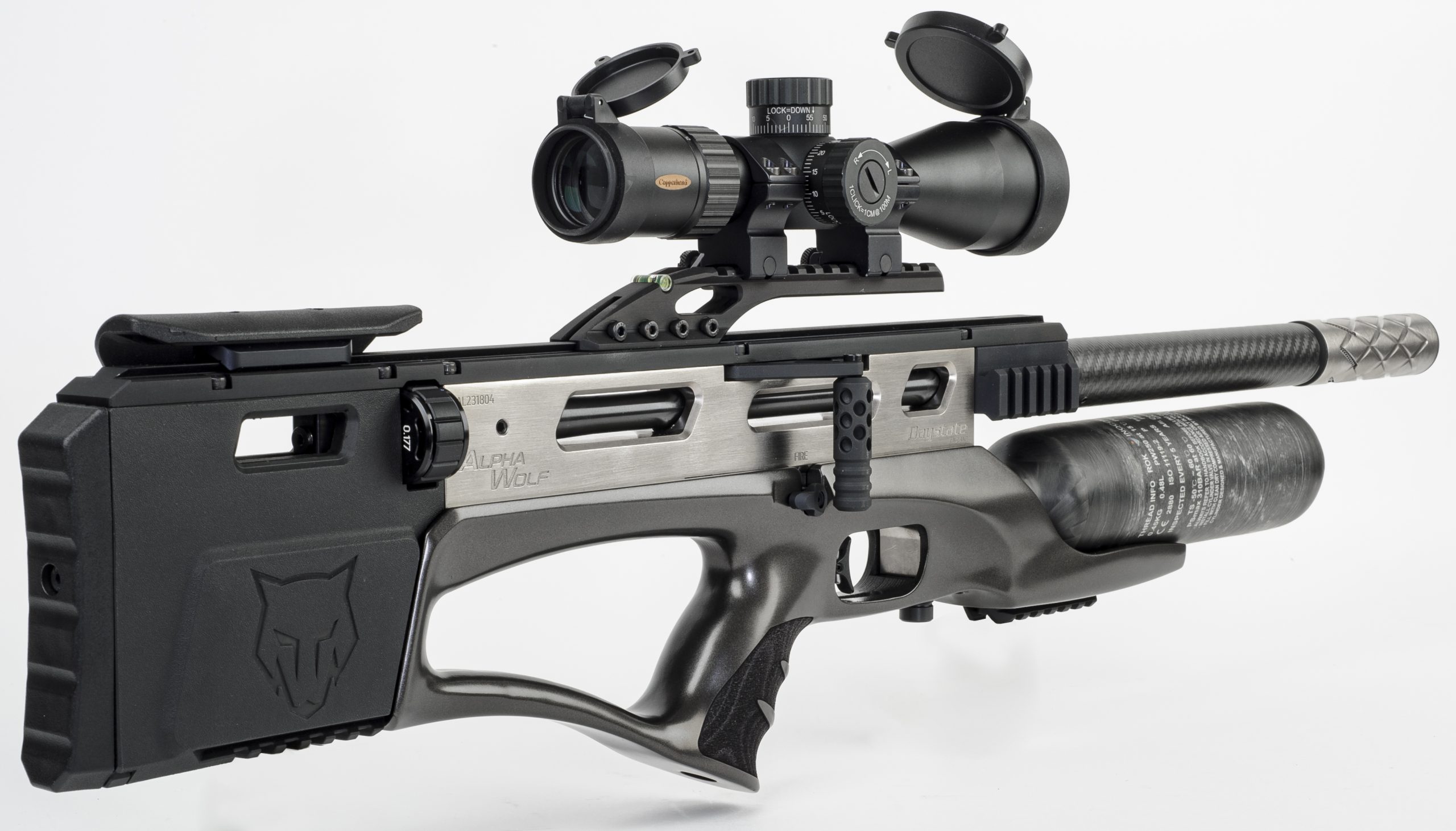

With the launch of the Alpha Wolf platform in 2020, Daystate introduced a significantly digitised approach to airgun engineering. The release of the new Alpha Wolf Carbon continues this trajectory, emphasising software integration alongside mechanical refinement.
When we spoke with Daystate’s Tony Belas to discuss the technical specifics of this new model, one of things that we wanted to clarify was what “ever-evolving electronic programming” — a phrase in the promotional literature — meant in practical terms for the end user.
How does Daystate software work in electronic air rifles?
Why was the Daystate Alpha Wolf Carbon introduced? “Mechanics evolve naturally,” Tony explains, outlining the company’s manufacturing process. “A barrel profile may change or a probe might shift from a pin to a shaft design. We do this constantly because we manufacture our own parts rather than relying on parts ordered in.”
The primary distinction of the Carbon model is its reliance on firmware updates. Tony draws a parallel with computing: hardware remains static but software evolves. While physical tooling requires significant lead time to alter, firmware can be updated rapidly to address feedback or improve efficiency.
Crucially, this architecture allows backward compatibility; owners of original 2020 models can utilise a Data Transfer Device (DTD) to upload the latest firmware (currently version 1.3.8), bringing earlier rifles up to the current operational standard now in use.
Is the Daystate Alpha Wolf legal for UK sub-12ft/lb use?
A key area of inquiry regarding electronic airguns is the extent of user control via the touchscreen interface. “The great limitation is the 12ft/lb rule,” Tony acknowledges. In markets where FAC regulations apply, users have direct control over voltage, stroke length and power output.
For UK sub-12ft/lb models, however, the software is locked to prevent the rifle from exceeding legal energy limits. The engineering solution involves a hard-coded ceiling set during assembly. Within this safety parameter, the software permits “standard settings,” allowing users to adjust power by percentage to tune for specific pellets.
Additionally, peripheral electronic features — such as the shot counter, display timeout and internal chronograph — can be toggled to optimise battery life.
Does the Alpha Wolf Carbon have a chronograph?
The Alpha Wolf Carbon integrates a chronograph into the barrel assembly to measure muzzle velocity. When asked about its accuracy relative to external consumer units, Tony argues that the integrated system reduces variables.
“The issue with handheld units is often the uncertainty of measurement,” he states, citing variables such as alignment, distance from the muzzle and rifle recoil. “If you recoil backwards, you can drop 5fps to 10fps in the reading.”
By fixing the chronograph to the barrel assembly, the sensors remain perfectly aligned at a constant distance, removing these external inconsistencies.
How do Daystate electronics improve shot consistency?
The rifle’s consistency relies on the interaction between the mechanical Huma-Air regulator and the electronic firing cycle. “The regulator becomes the controlling factor,” Tony notes. While mechanical regulators are effective, they are subject to minor pressure variances during rapid cycling.
In the Carbon, the electronic solenoid compensates for this by controlling valve opening times with micro-second precision. This hybrid approach aims to mitigate mechanical variance, theoretically offering a more consistent shot cycle than a purely mechanical system.
What is the Alpha Wolf Carbon stock made from?
Externally, the Carbon is distinguished by its carbon-fibre-coloured stock and nickel-plated action. Tony describes the finish as a deliberate aesthetic choice, reminiscent of previous limited runs like the Alpha Wolf Limited Edition.
While the carbon-fibre look offers rigidity, the primary driver for this variant is visual distinctiveness and pride of ownership. The Alpha Wolf Carbon essentially represents the maturing of the electronic platform, balancing traditional mechanical requirements with the adaptability of modern software.
The Black Wolf Zero
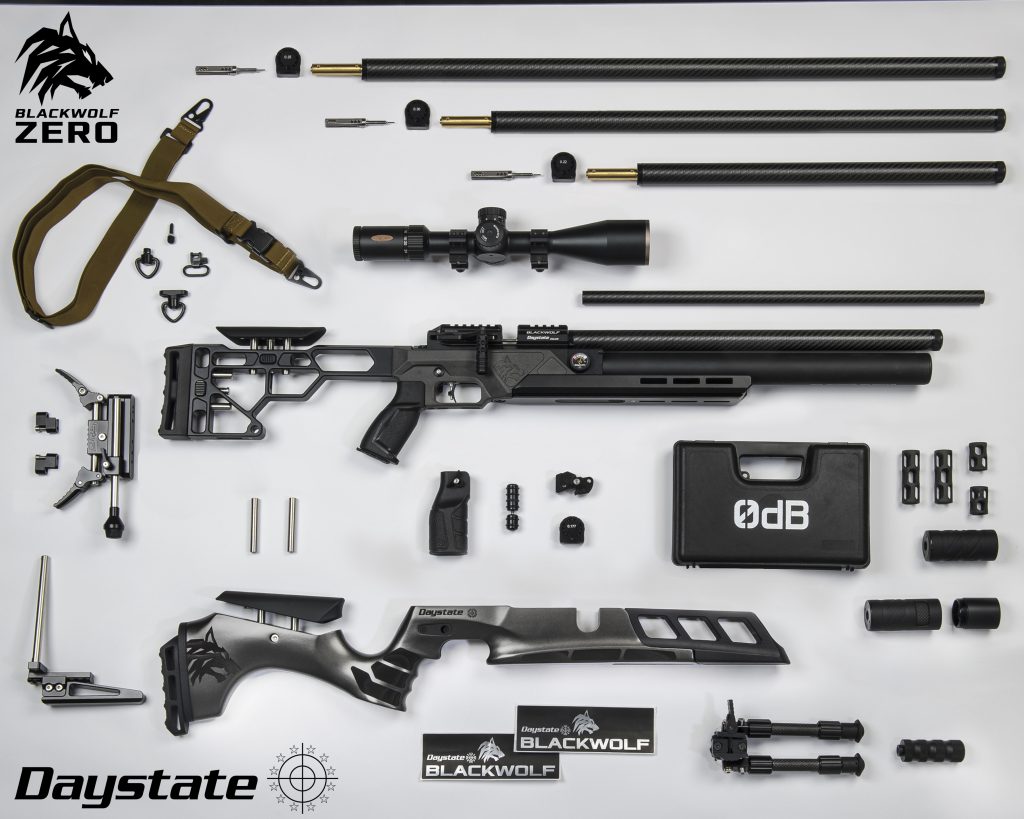
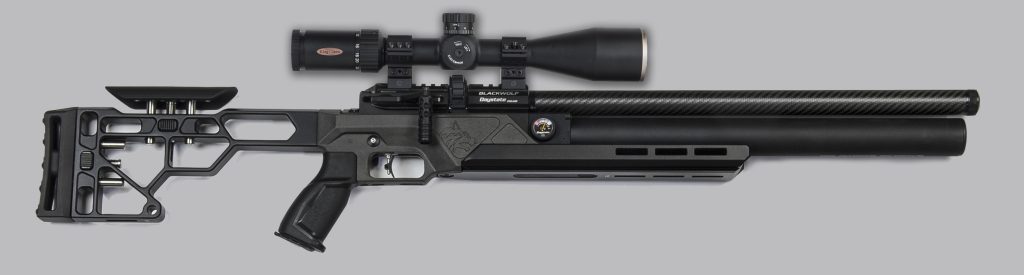
Following the release of the Alpha and Delta Wolf platforms, Daystate has expanded the range with the Black Wolf Zero. While the flagship “Tac” editions arrived with a comprehensive suite of accessories and a correspondingly high price point, the Zero takes a different approach. According to Tony, it is positioned not as a “budget” alternative, but as a “baseline” platform — a foundation for shooters who intend to customise their setup and do not require the factory-standard accessory package.
What makes the Black Wolf Zero different from others in the Daystate range?
“The idea behind the Zero is to give people a baseline gun which is considerably cheaper than the full-specification model,” Tony explains. This strategy addresses a common redundancy where users purchase a high-end rifle only to immediately replace the stock grips or rails with aftermarket alternatives.
What is the price of the Daystate Black Wolf Zero?
How much does the Black Wolf Zero cost? To achieve a price point of approximately £1,954 — down from the £2,650 of the fully-equipped model — specific components were substituted. The adjustable target grip is replaced by a standard generic grip; the complex biathlon-style cocking lever is swapped for the standard lever used on the BRK range; and the front Picatinny rail has been shortened.
“We removed components while leaving the gun fully functional,” Tony notes. “Reducing the length of the front rail lowers both manufacturing costs and the overall weight of the unit.”
Are the components compatible with others in the Black Wolf range?
A critical concern with entry-level variants is component compatibility. Tony confirmed that the Zero retains the modular architecture of the wider Wolf family. Accessories such as the barrel tensioner, hook kit and single-shot loaders remain fully compatible. However, there is one significant technical limitation regarding air capacity: the Zero’s 300cc cylinder cannot be upgraded to a carbon bottle.
“To keep the price at that level, the Zero does not have as much flexibility to change to a bottle version,” Tony clarifies. This fixed configuration is a key differentiator from the more expensive models.
Can you change the calibre on a Daystate Black Wolf?
The Zero retains the platform’s calibre-change capability. Tony described the process as taking approximately three minutes, involving the removal of the probe and the loosening of two barrel retention screws.
We also discussed the High Power (HP) models and the requirements for shooting slugs. Tony offered a candid assessment of “hybrid” barrels. “Using a pellet barrel with slugs, or a slug barrel with pellets, is a compromise,” he admits. “If you are trying to shoot an airgun at 100 metres, the last thing you need is a compromise.”
To address this issue, Daystate supplies a dedicated 28in Lothar Walther barrel specifically for slug configurations. This increased length is necessary to generate the higher velocities and ballistic coefficients that are necessary for long-range slug shooting.
The Black Wolf Zero represents a strategic shift, acknowledging that many modern shooters prefer to build a rifle to their own specifications. By offering the core engine and chassis at a lower entry price, Daystate provides a functional platform that allows users to select their own ancillaries, rather than paying for a factory configuration they may ultimately alter.
The starting prices of the Alpha Wolf Carbon and Black Wolf Zero are £2,400 and £1,850 respectively. For information, visit daystate.com
Related Articles
Air rifles
Uncategorized
A Wolf with a real bite
Dave Barham tests the mechanical masterpiece from Daystate.
By Airgun World
Air rifles product reviews
Skout Evo
Dave Barham tests the highly anticipated Skout EVO, all the way from the US.
By Dave Barham
Get the latest news delivered direct to your door
Subscribe to Airgun World
Unlock the world of airgun shooting with a subscription to Airgun World magazine, Britain’s biggest-selling airgun publication.
Written by passionate, long-term airgun enthusiasts, each issue delivers expert insights, comprehensive gear reviews, and invaluable tips to enhance your shooting skills. Whether you’re a seasoned shot or new to the sport, Airgun World offers essential content covering shooting techniques, classic airguns, and the latest equipment innovations.
Save on shop price when you subscribe and pay just £4.07 per issue – 42% cheaper than buying in-store at £6.99!