★ Competition – win a Vantage riflescope worth £279 – enter here! ★

Bell target shooting: more than just a pub sport
Mark Camoccio heads deep into Lincolnshire for his first proper look at bell target shooting, an air rifle discipline steeped in history and quietly thriving in the back rooms of local pubs


Bell target is a discipline within shooting sports, one which has its own devoted following. I must admit to knowing only the very basics prior to getting involved. I knew it came from the Midlands, and I’d heard it had a connection with pubs, but that was about it.
Bell target is fascinating. It has its origins firmly in the Midlands and Black Country area in the early 1900s, when Field Marshal Frederick Sleigh Roberts famously noted that British troops fighting the Boer War in South Africa were very poor marksmen. He lobbied Queen Victoria to improve shooting skills, and short-range air rifle shooting was encouraged thereafter with the endorsement of Lord Baden-Powell, the founder of The Boy Scouts Association. Paper targets were used initially, but the discipline soon evolved to a bell system, and a sport was born. Bell target was regularly shot in local pubs, and at its height, there were 1,600 teams competing.
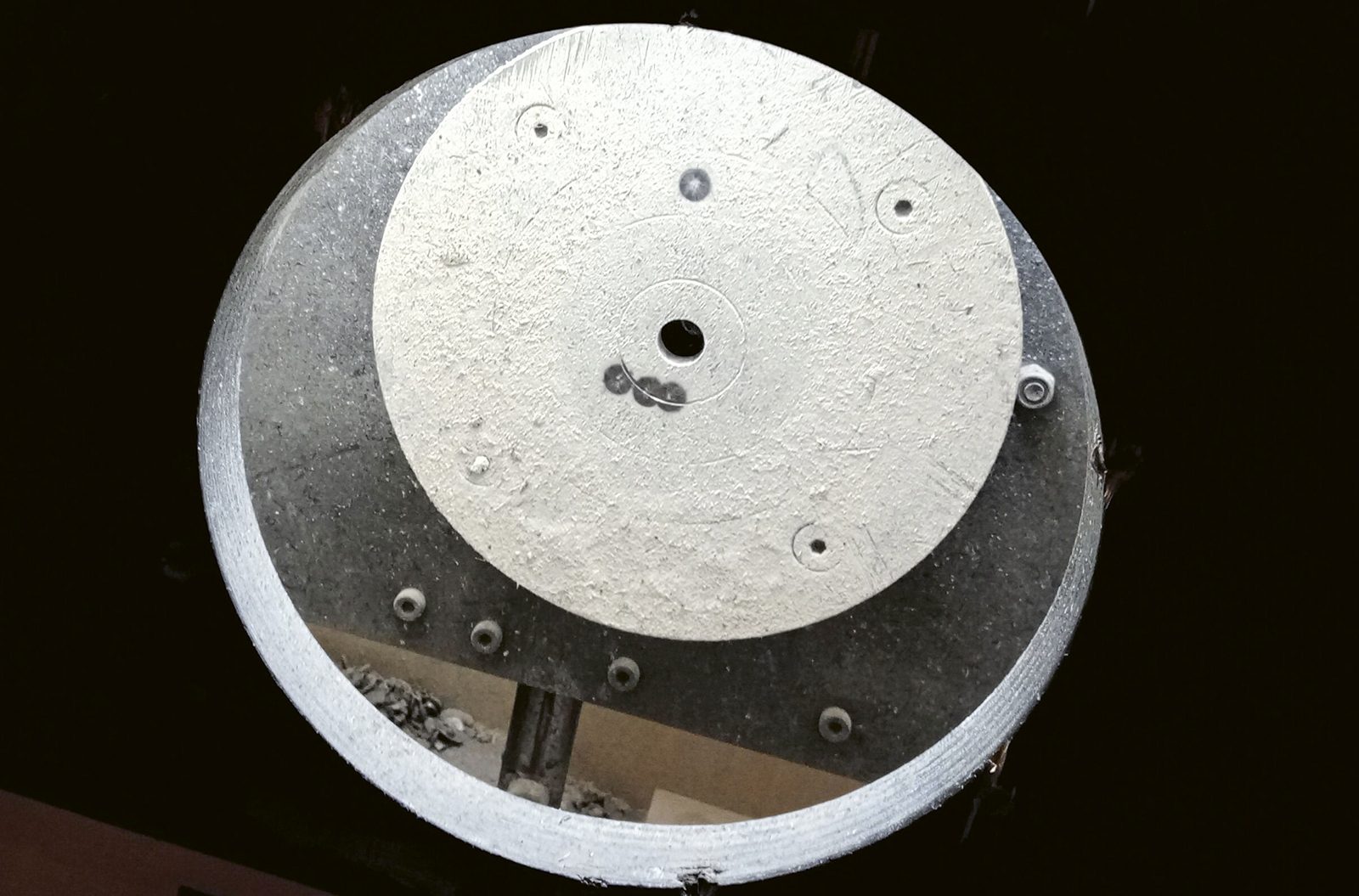
The target specification
Rules arrived shortly thereafter, including specifications for the target, which state that the bull (the central hole) needs to be 3/8 inch and shot at a distance of six yards (18ft). This represents the size of a human head in the sights, viewed at 100 yards. The target needs to be constructed of reinforced thick steel plate to properly withstand close impact, and the box needs to be set so that the bull stands five feet high.
On the target, there are four outer rings marked around the bull. A shot through the centre scores 5.5 points, then the rings score five, four, three and two points respectively. Hit the line and you score up. Some clubs design the target to show a light when the bell is rung, as well as a flag, with the idea being that in a noisy pub, the bell may not be so easily heard.
Meet Jim Brown
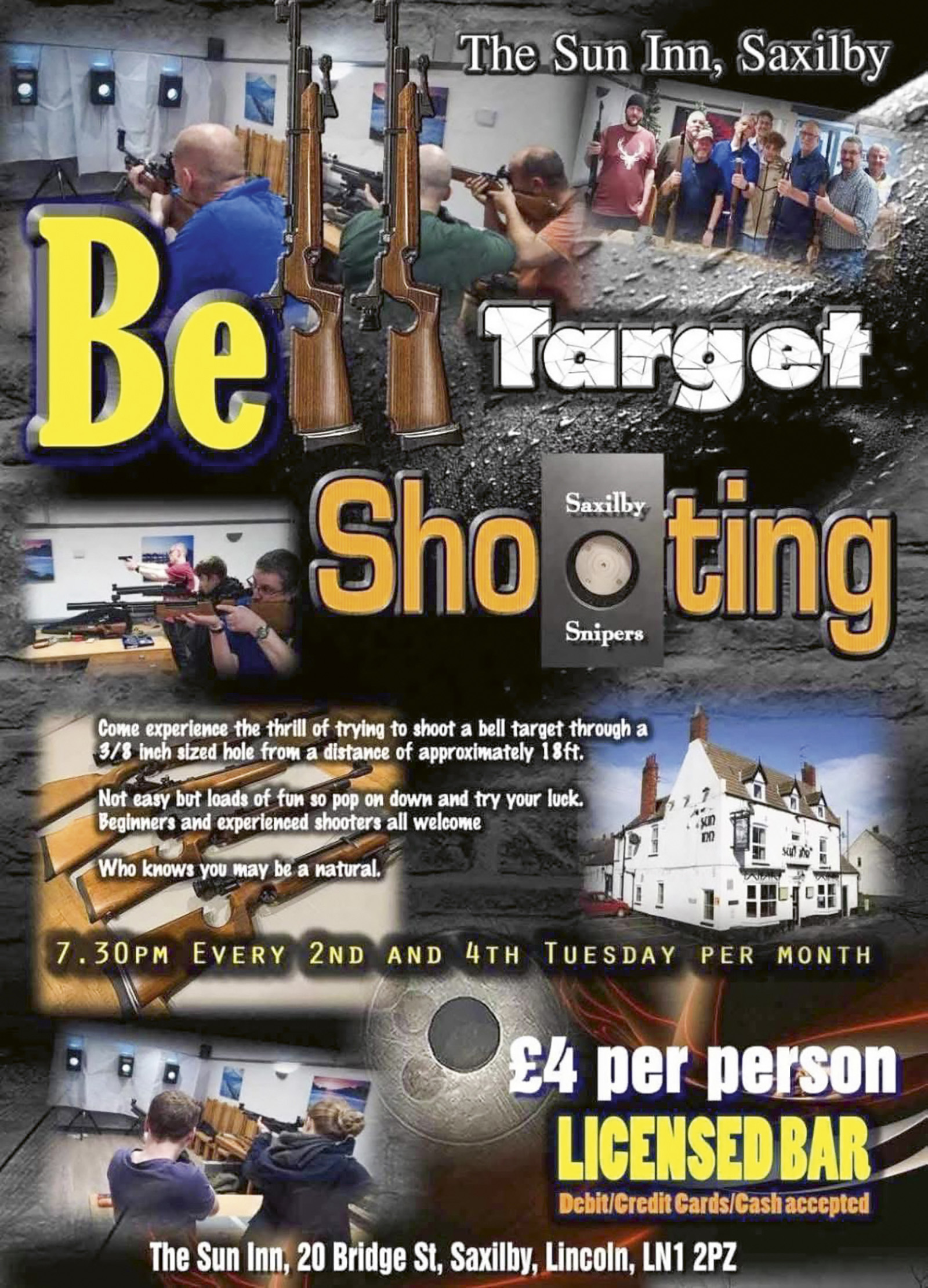
To learn more, I headed deep into Lincolnshire. Jim Brown was my contact and, as vice chairman of the Lincolnshire Bell Target League (LBTL), it’s fair to say he knows his subject. Cliché or not, Jim’s enthusiasm really is infectious. Having now seen him in action, orchestrating a Tuesday night down at the Sun Inn public house in Saxilby, it’s hardly surprising the sport has taken off in those parts. The Sun Inn, incidentally, is the oldest venue for the sport in Lincolnshire, having been set up in 2017, and I was eager to see just how popular it was.
First impressions were of a pleasant pub with a welcoming atmosphere. Arriving early, I saw the transformation take place in the back room, as punters finished up their game of pool and replaced the large wooden protective covers on the tables, which instantly became tables to hold airguns and paraphernalia. Jim wasted no time setting up the instant range, consisting of mobile rails with car airbag material acting as a safe backstop.
Shooters slowly arrived and began booking in before readying their kit. Anyone wishing to take part on the night pays £4, and for a whole night, that sounds pretty cheap. Guns are available to use, but most shooters buy their own eventually, with 25 to 30 turning out on a typical night.
Into the detail
Each competitor shoots a detail of five shots from a standing position, although there is special provision for disabled shooters with a purpose-made, spring-loaded rest. After each shot, the spotter – normally Graham – goes up to the target, resets the bell flag or lights if necessary, and calls out the scores, which are then recorded by his son Jayden in the chart. A special non-drying paint is used to dab over shots after each detail, and this is a mix of titanium dioxide and oils. In addition, running scores are relayed to the big electronic display on the wall, along with colour coding to show who holds first, second and third placings, which all adds to the excitement.
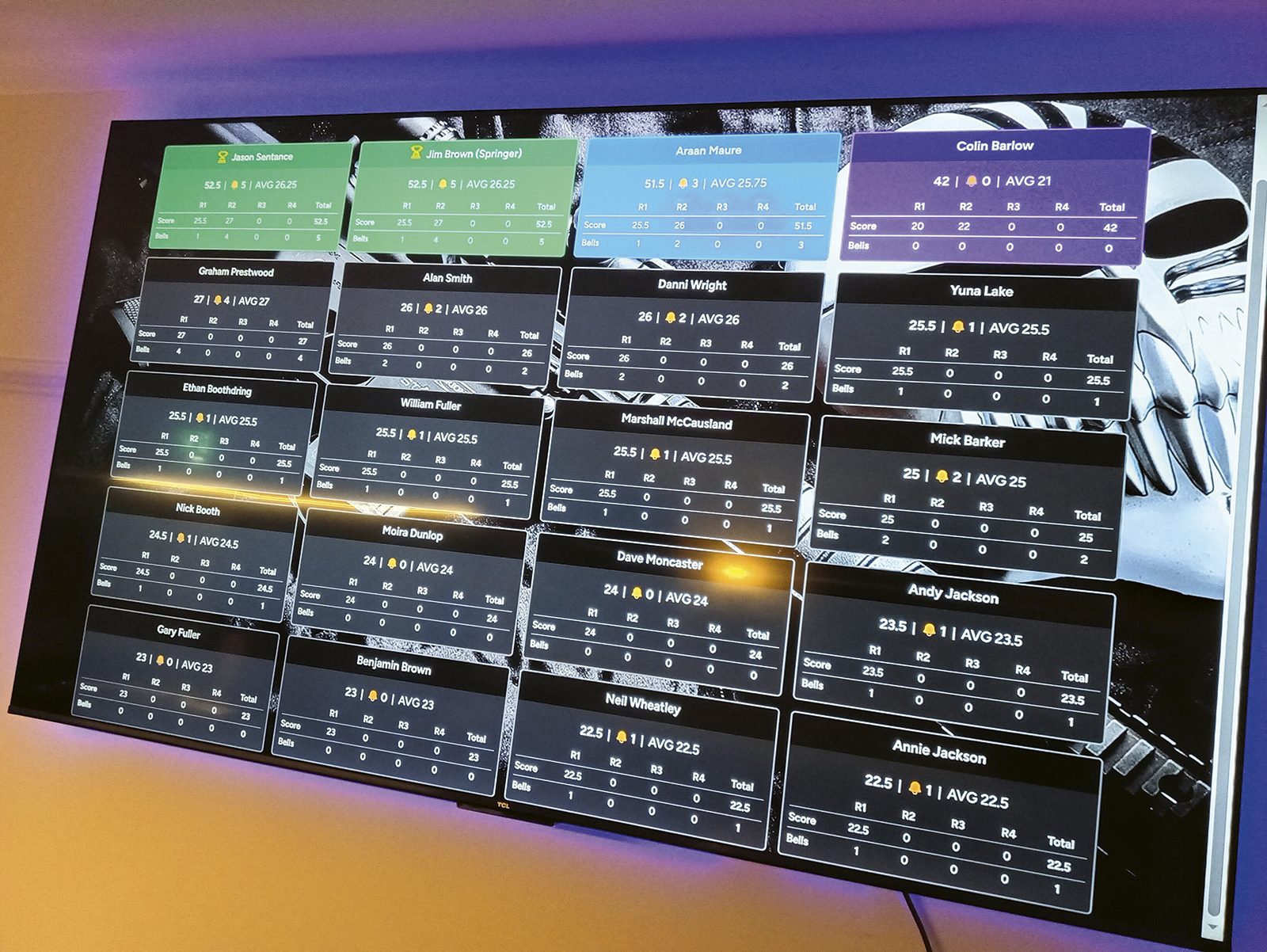
Each shooter ends up taking 20 shots in all (four lots of five shots), so the maximum score possible is 110 (4 x 27.5). On the night, family rivalries are all part of the fun. Annie and Andy Jackson certainly think so, telling me they had been coming for just two months, but were already hooked. “It’s just great fun and a great atmosphere, but Annie normally beats me,” Andy joked.
What gun?
I ask Jim what restrictions there are on guns and sights. “While some areas restrict airguns to 6ft/lb, our Lincolnshire league permits any legal airgun sub-12ft/lb in .177 calibre, so as to be as unrestrictive as possible,” says Jim. “However, specialist target clothing, square Olympic shoes and official strapped shooting jackets are not permitted – again, to keep things inclusive. Open sights are utilised, including fibre optics and dioptres, but no red dot systems.”
Unlike indoor 10m shooting where “wadcutter” flat-headed pellets were favoured as they punched a clean hole in paper targets (now superseded by electronics), with no paper in use in bell target, dome-headed pellets are actually favoured, since these leave a spot of lead on the target, which is just easier to score.
Safety first
Everything is super safe and well organised, down to “safe and empty” flags inserted in the barrels. Amazingly, at one point back in the day, bell target shooting would take place across a crowded bar, with cries of “heads up” or “heads down” regarding whether it was safe to get up. Thankfully, that custom is outlawed today, and I can personally vouch for a somewhat safer setup.
The social aspect is key too; when shooters have finished their detail, they can simply pop through into the bar and savour the delights. Everyone seemed friendly, and with the LBTL alone now attracting over 300 shooters, they’re obviously doing something right. The region also operates a virtual league, where scores are submitted online, and the modest Jim Brown, after some coaching, admitted he’s won this twice.
A blueprint for success
Some bell target shooting still takes place in the Midlands, Norfolk and Shropshire, and from what I’ve seen and heard, the Lincolnshire league is clearly thriving. At a time when pubs are suffering and feeling the pinch economically from all sides, it seems to me that staging bell target could be a blueprint for success. Of course, you need the energy and enthusiasm of people like Jim Brown, but it’s heartening to see such an activity first-hand and experience the pleasure it’s bringing to the community.
For more information, visit belltarget.com, lincolnshirebelltargetleague.co.uk and lbtl.co.uk.
Frequently Asked Questions
What is bell target shooting?
Bell target is an air rifle discipline with its origins in the Midlands and Black Country in the early 1900s. Competitors shoot at a steel target with a 3/8 inch central hole, or bull, from a distance of six yards (18ft), with a bell sounding when the bull is struck. It was traditionally shot in pubs and still is across Lincolnshire, the Midlands, Norfolk and Shropshire.
How is a bell target scored?
A shot through the central hole scores 5.5 points, and the four concentric rings around it score five, four, three and two points working outwards. A pellet on the line scores the higher value. Each competitor shoots four details of five shots, 20 shots in all, for a maximum possible score of 110.
What air rifle do you need for bell target shooting?
It varies by league. The Lincolnshire Bell Target League permits any legal sub-12ft/lb air rifle in .177 calibre to keep things inclusive, with open sights including fibre optics and dioptres, but no red dot systems. Specialist target clothing and strapped shooting jackets are not allowed. Dome-headed pellets are preferred over wadcutters, as they leave a clearer mark on the steel for scoring.
Related Articles
Is airgunning the solution for grey squirrels?
Defra's latest grey squirrel policy recognises the practical conservationists keeping grey numbers down, and in many cases that means airgunners. Here is why the air rifle remains one of the most effe...
By BASC
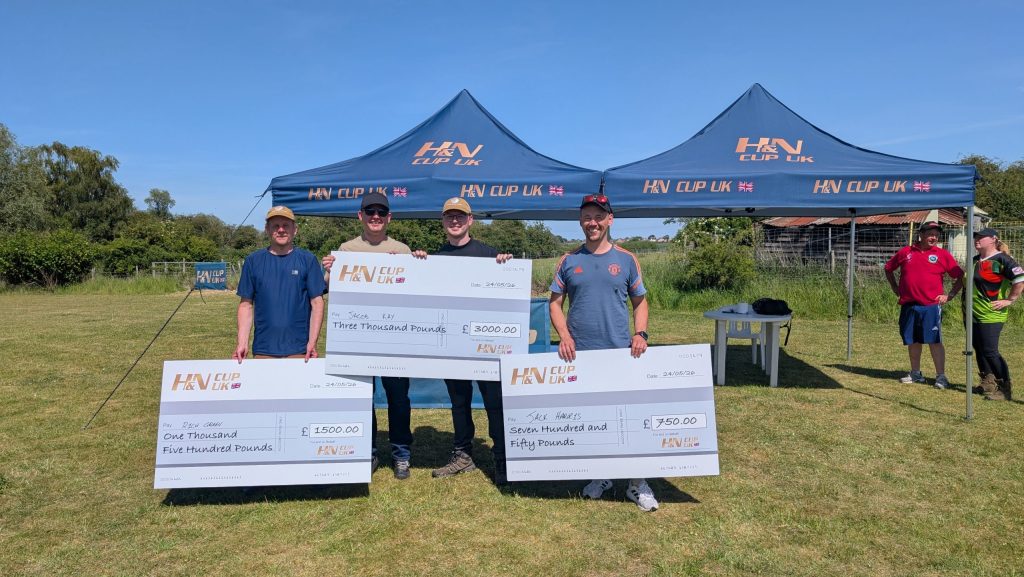
Jacob Kay wins H&N Cup with record £10,000 prize pot
Competitors contested a record £10,000 prize fund at East Tree Field Target Club on the May bank holiday weekend.
By Hollis Butler
Get the latest news delivered direct to your door
Subscribe to Airgun World