★ Competition – win a Vantage riflescope worth £279 – enter here! ★

Meet guest editor Dave O’Hara – June
World Field Target Federation president Dave O’Hara shares the story of his competitive drive, the challenges of international logistics and mentoring the next generation of shooters
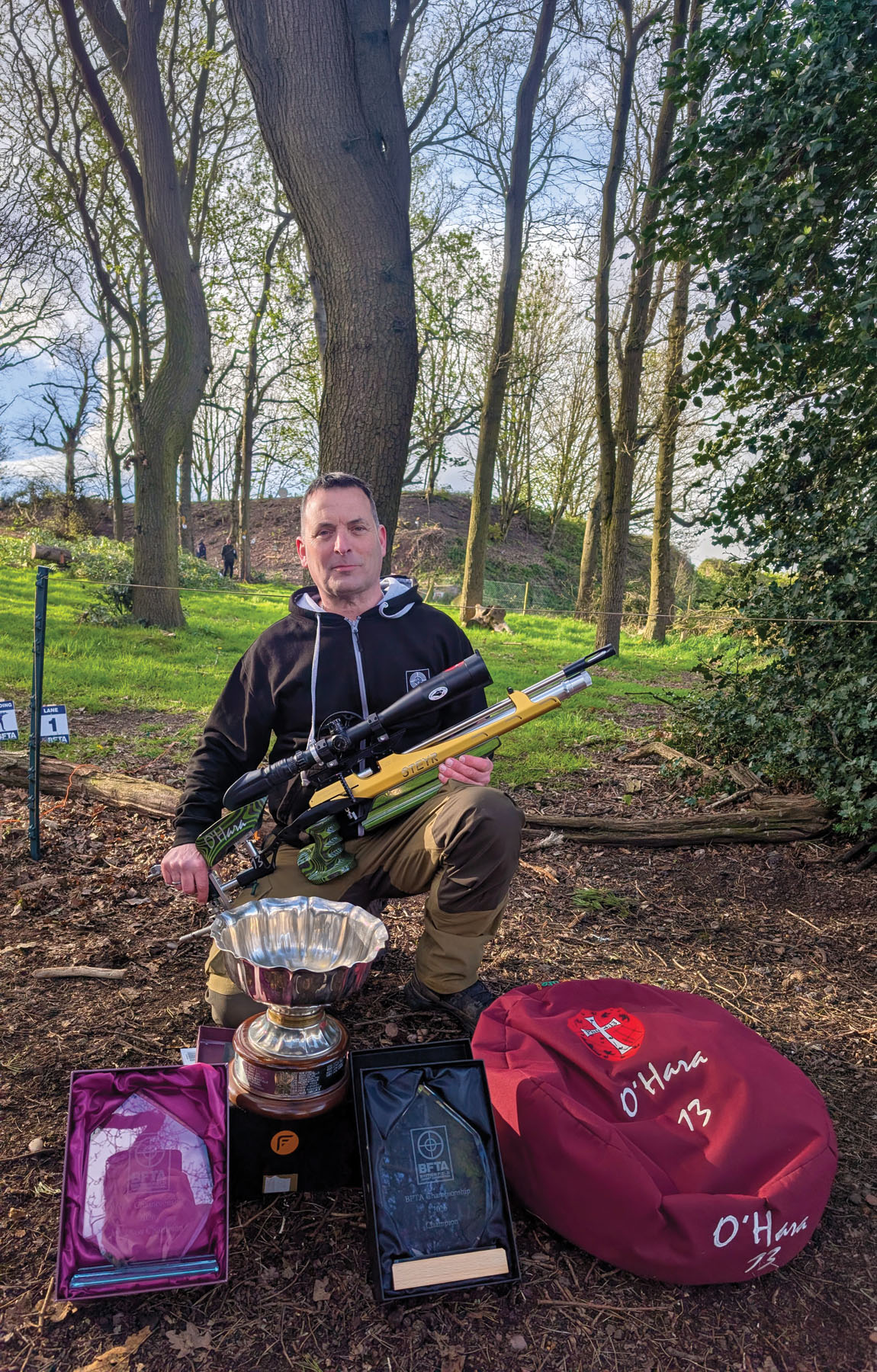

Airgun World (AW): Who is Dave O’Hara?
Dave O’Hara (DOH): I am the president of the World Field Target Federation (WFTF) and the secretary of the Northern Ireland Field Target Association (NIFTA). My background was originally in cycling as a downhill mountain biker. I got into shooting through a friend, initially for hunting, though I had no real interest in that side of the sport.
Eventually, I was talked into competing in an FT shoot. I did that at a high level for a few years and then moved into 1,000-yard high-power shooting, but found my way back to FT. It has been a long journey, but the competitive drive has remained the same throughout. I compete in as many FT Grand Prix and international shoots as I can. I also won the British Field Target Championship in April with my trusty Steyr LG110.

AW: What was the very first air rifle you ever owned, and do you remember the moment your interest shifted from target shooting in your spare time to serious competition?
DOH: My first gun was an Air Arms S410 in .22 calibre. It was a hunting gun, but I entered a high-power FT competition and ended up winning the championship. I didn’t pay attention to the 12ft/lb shooters until someone told me no one from outside their club had ever cracked the top 10 in that league.
That instantly lit a fire in me; I decided right then that was going to change. I rang the late John Sykes at Hydrographics and ordered a bespoke S410 Carbine in a Paul Wilson stock with a Deben 10-50×56 scope fitted. Two weeks after zeroing it, I was on my way to the 2002 World Championships in Norway, where I placed ninth in only my fourth-ever 12ft/lb shoot.
AW: What are your clearest memories of those early club shoots and the equipment being used at the time?
DOH: I grew up in a village called Bessbrook and joined the Down Field Target Club. Back then, there was no social media; it was all magazines and word–of-mouth. I remember seeing an Air Arms RN10 on the cover of Airgun World with a big side wheel and string hanging from it, and I was horrified! I thought, “What’s all this stuff on airguns? These people must be head-wrecked.”
Once I went to my first competition (which I won) and saw the technical aspects, tuning guns and pellets, and how important the optics were for range finding I was hooked straight away.

AW: Who were the mentors when you first started to appear on the competitive circuit?
DOH: There was an old guy in the club called Dougie Hegney. He had a Theoben Rapid 7 in .177 calibre with a Paul Wilson stock. When I saw that, it was like looking at an F1 racing car compared to our sporting guns. Dougie recognised immediately that I could go far and pointed me in the right direction. He wasn’t necessarily a world-class shot himself, but he had the eye for talent and the right kit.
If he hadn’t been there that day to show me what an FT could actually look like, rather than a standard air rifle, I might not have gone back. I was like a magpie attracted to the engineering and the potential of the equipment.
AW: Was there a specific “lightbulb moment” in your early shooting career when you realised you had the temperament for high-level international competition?
DOH: It was with Dougie again. We used to shoot out to 58 yards in an open league. I missed the target one day and was surprised, and Dougie leaned over, put a hand on my shoulder and said, “That’s the difference between you and us. You expect to hit that, we expect to miss it.” That made me realise my thought process was fundamentally different.
Coming from downhill mountain biking, where I won a national championship by four-thousandths of a second, I understood that mental pressure was intense but was also an asset. Your thought process is of paramount importance; in mountain biking, you learn to manage adrenaline and focus, and I found those skills transferred perfectly to the firing line.

AW: Which brands do you currently work with, and of what does your current set-up consist?
DOH: I use a Steyr LG110 as well as an Air Arms XTI with a Vector Optics Continental scope and JSB pellets, housed in a custom stock by Brian Marsh. I also have a great ISP Mk4 Airstream with a beautiful Brian Marsh stock that I use. It’s about finding the combination that gives you that ultimate confidence when you settle into a lane.
AW: Looking back at the rifles and optics of your youth, which piece of “vintage” kit do you most regret parting with?
DOH: The S410 with the Paul Wilson stock and the Deben scope I used at my first Worlds. I’d love to have that back for sentimental reasons. Most likely, you couldn’t compete with the old gun and optics now. In this game, no matter how good you are, if your equipment is even a little off, you aren’t going to win. You need to own kit that is at least equal to everyone else on the line.

AW: What initially motivated you to take on the presidency of the WFTF?
DOH: When I came back to the sport after a 13-year break, I became the secretary for Northern Ireland Field Target Association. I’m quite organised and au fait with the rules. I went to one World Championship that was, unfortunately, poorly organised. I was one of the people who stood up at the front and said, “Look, we need to do this and that to fix this.”
When the previous president, Sergio Rita, had to step down, he asked if I would do it. I believe the sport and the people aren’t here to serve me; I am here to serve them. I have the time, the will and the dedication. If I can lift the standard then it benefits everyone.
AW: How do you balance the traditional roots of FT with the modern demands of a growing international competitive circuit?
DOH: It’s about sharing knowledge to ensure that if problems happen, we overcome them together. Sergio did a fantastic job of standardising the rules because people were always pushing boundaries.
I tweaked them slightly for 2025; just small changes to ground positions for discipline changes and so on, but the core is about planning in advance to minimise risk and enhance rewards to the shooters who are often paying out of their own pockets to travel to these events. We have to be professional while remembering that for most, this is a passion they fund themselves.

AW: What does a “typical” day look like when overseeing an association that spans so many different countries and cultures?
DOH: It depends on the time of year. If there is an international shoot, like the Europeans in Italy this July, I’m doing a lot of sponsorship and logistical work — connecting organisers with sponsors and navigating the nightmare of customs.
For the Worlds, I work with organisers in places like Canada to provide a “package” so they aren’t reinventing the wheel. I hand over everything from import/ export information to sponsorship leads. My goal is to give them a ball to keep rolling rather than making them create the ball themselves from scratch.
AW: What has been your proudest achievement during your time with the WFTF?
DOH: The World Championships we ran in Northern Ireland last August. It was a massive team effort where everyone in the federation gave up their entire domestic season to give back to the sport. Seeing that showcase go as well as I expected was a moment of great pride.
On a personal level, I still value winning the Northern Ireland championships immensely because of the heritage and the names that have gone before. I believe my best days are still ahead of me, and I’m shooting better now than when I was top 10 in the world 20-odd years ago.
AW: We’ve seen FT explode in popularity; which regions do you think will be the “ones to watch” in the next five years?
DOH: The nucleus is still Great Britain because the 12ft/lb airgun isn’t licensed there, making the sport far more accessible. You can buy a gun today and change it tomorrow, whereas here or abroad, you might wait six months for a licence only to find you don’t like the rifle.
As for shooters, the top 10 in the world are usually the same names. There are about 20 people who could realistically win the Worlds on any given day, and that level of competition is what keeps the sport exciting.
AW: With the World Championship becoming such a high-profile event, how do you ensure the courses remain challenging for elite shooters without discouraging newcomers?
DOH: It really is a balance. You want to push the bar high. I really admire the shooters who are out there pushing the edge of what’s possible, and I try to uphold that trait. I am constantly looking for that competitive advantage.
Speaking for myself, it’s not just about winning, it’s also about how you win. I like to be the guy who people ask, “How did he do that?” We try to maintain that level of challenge to keep the sport’s pinnacle exactly where it should be, while ensuring the event remains a rewarding experience for everyone involved.
AW: Many shooters argue over the “PCP vs springer” divide; do you think there is still a place for the traditional piston rifle at the highest levels of international competition?
DOH: Absolutely. The Springer class is well-represented and the shooters are made of the same stuff as PCP shooters; they just choose a different challenge. There is a divide because a springer isn’t as consistent as a PCP, so you can’t compete them together, but FT is as much about the springer as it is the PCP. It’s the capability of the gun that differentiates the scores, not the quality of the shooter.
AW: What is the one piece of advice you find yourself giving most often to shooters who have hit a “plateau” in their scores?
DOH: I ask them “How bad do you want it? “Are you prepared to pay the price?” Then we look at the equipment and the effort. Are you just throwing lead downrange, or are you looking for precision? You have to learn from every miss.
If you just keep shooting until you knock it down, you haven’t learned anything. Practice does not make perfect; perfect practice makes perfect. If you practice the wrong thing, you just get better at being wrong.
AW: How are the WFTF and local organisations working together to encourage younger generations to put down the consoles and pick up a target rifle?
DOH: It’s close to my heart. We support junior categories with nice prizes and run open days with youth groups like the Scouts to try and attract fresh blood. The licensing laws in places like Northern Ireland make it hard, as the “cooling off” period can stall interest.
In Great Britain, it’s easier for a kid to try a gun and have their dad buy one the next day. We’re trying to reach them through social media, hoping to peel them away from games like Gears of War to come out and do it for real. It’s a constant battle for their attention, but we are doing our best to engage them.
Related Articles
Features, interviews and advice
Interview with Edward King, managing director of Anglo Spanish Imports (ASI)
ASI’s Edward King explores the craftsmanship behind Cometa, technical breakthroughs with SKOUT and the vital importance of UK-specific R&D and in-house dealer support
By Martin Puddifer
Features, interviews and advice
Terry Doe has a question for online boasters
Tired of reading yet more irresponsible boasting online about air rifle prowess, Terry Doe has a simple question which may stump a few people: are you as good a shot as you think?
By Terry Doe
Get the latest news delivered direct to your door
Subscribe to Airgun World
Unlock the world of airgun hunting and target shooting with a subscription to Airgun World magazine, Britain’s biggest-selling airgun publication. Written by passionate, long-term airgun enthusiasts, each issue delivers expert insights, comprehensive gear reviews, and invaluable tips to enhance your shooting skills. Whether you’re a seasoned shot or new to the sport, Airgun World offers essential content covering shooting techniques, classic airguns, and the latest equipment innovations.
Save on shop price when you subscribe and pay just £4.07 per issue – 42% cheaper than buying in-store at £6.99!